Radio Brisvaani

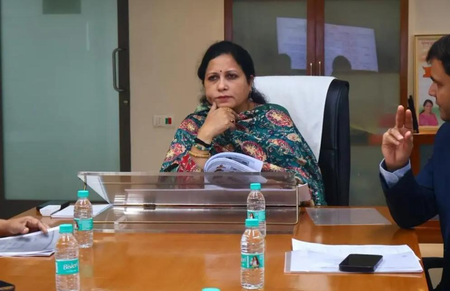
Gandhinagar, March 12 (IANS) Women and Child Development Minister Dr Manisha Vakil on Thursday hit back at the Congress in the Gujarat Assembly while replying to remarks by MLA Jignesh Mevani on Anganwadi workers and malnutrition, saying the condition of Anganwadi centres had significantly improved under the present government.
Participating in the debate on the Women and Child Development Department’s budgetary demands of Rs 7,689.84 crore, Vakil said those questioning the government should recall the earlier situation.
“Those who ask what has changed should know that during the Congress rule Anganwadi registers were eaten by termites and no one knew where the ration went,” she claimed.
She further added, “Today, under the leadership of Prime Minister Narendra Modi and Chief Minister Bhupendra Patel, Anganwadi workers have smartphones and the ‘Poshan Tracker’ application, through which the services reaching children in the remotest areas are monitored in real time. Technology has brought transparency to the last citizen.”
Her remarks followed Mevani’s speech in the House in which he raised concerns about frontline workers and nutrition levels in the state.
He said ASHA workers and Anganwadi workers continued to work without adequate wages and benefits and asked when the government would recognise them as “Ladli Behnas”.
“This is not good for Gujarat that ASHA workers remain deprived of pension and even minimum wages. ASHA worker sisters survive only on incentives. If we do not give them minimum wages today, then when will we give them?” Mevani said.
He also referred to malnutrition figures while speaking about conditions among tribal communities.
“With so many big real estate heads, business tycoons, so many corporate companies, Anand’s Amul Dairy, Dudhsagar Dairy, Banas Dairy, and the BJP government with more than 150 seats and 28 years of rule, yet one statistic repeatedly appears on record — 40 out of 100 children are malnourished,” he told the House.
Responding to the criticism, Vakil said Anganwadis in Gujarat had evolved from poorly-maintained facilities to technology-enabled centres.
“There was a time when Anganwadis meant dark rooms and schemes remained only on paper, being lost in the well of corruption. Today Anganwadis in Gujarat have become ‘smart’, where children are receiving education through smart TVs and modern methods,” she said.
The minister said the state had introduced digital monitoring systems to track nutrition services.
Through the ‘Poshan Tracker’ application, she said, authorities could monitor details such as the weight of a child in a remote tribal village and the milk provided to that child.
According to Vakil, more than 53,000 Anganwadi centres serving around 48 lakh beneficiaries were being brought under an AI-based attendance and image-processing system, for which Rs 5 crore had been allocated.
She said QR code technology had also been introduced in the distribution of take-home ration to create what she described as a “digital shield” and ensure transparency.
Referring to nutrition outcomes, Vakil said the state had recorded improvement compared with the National Family Health Survey-5 (2019–20).
“With the resolve of a malnutrition-free Gujarat, significant results have been achieved by January 2026. The proportion of underweight citizens has come down from 39.7 per cent to 11.4 per cent, marking a reduction of 28.30 per cent,” she said.
Vakil also said Anganwadi centres were being upgraded into “smart learning centres”.
More than 1,000 new Anganwadi centres had been inaugurated since January 2025, while Rs 360 crore had been allocated in 2026–27 for new Anganwadi buildings.
Highlighting women-focussed initiatives, she said Gujarat had one of the highest shares of gender budgeting in the country, with around 39 per cent of the 2025–26 state budget earmarked under the gender budget framework, covering nearly 770 schemes for women.
Under the ‘Chief Minister Matrushakti Yojana’, Rs 284 crore had been allocated for 5.22 lakh pregnant and lactating mothers.
The minister said assistance had been approved for 3,35,607 girls under the ‘Vahli Dikri’ scheme aimed at encouraging the birth and education of girls, with online application and real-time tracking facilities provided.
On women’s safety, she said 17.96 lakh women had received assistance through the ‘181 Abhayam’ helpline, including 3.58 lakh cases where immediate rescue teams reached the spot.
The state also had 270 ‘Nari Adalats’ (women’s courts) functioning for amicable resolution of family disputes.
Vakil said Anganwadis were also supporting early childhood education through programmes such as the ‘Pa Pa Pagli’ project, for which Rs 14.85 crore had been allocated, while Rs 205 crore had been earmarked under the ‘Dudh Sanjeevani’ scheme benefiting about 13.5 lakh children.
She also referred to the ‘Balika Panchayat’ initiative that began in Kutch’s Kunariya village and had expanded across the state, where girls aged 11 to 21 take part in discussions on issues such as child marriage and adolescent health.
“Children’s health is not an issue of any one party but of the entire society. Everyone must work together to build a strong India through a ‘Suposhit Gujarat’,” she said.
The Assembly later passed the budgetary demands of Women and Child Development Department.
–IANS
mys/rad