Radio Brisvaani

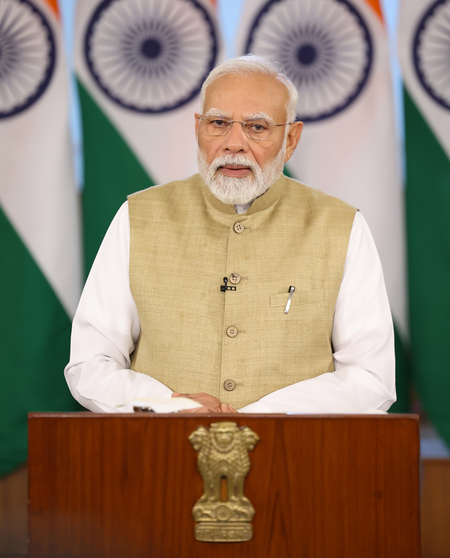
New Delhi: When Prime Minister Modi briefly addressed the nation in the wake of Operation Sindoor, on May 12, he laid down some postulates that could be deemed to be a part of the country’s national security policy.
Many strategic analysts had been advocating for a formal declaration of National Security Policy (NSP) little realising that the release of any of its details in public domain could benefit the opponent and also that such a policy might require revisiting because of the changes in geopolitical scenario affecting the international spectrum of friends and adversaries.
Prime Minister Modi’s statement that any further terror attack from Pakistan will be considered as an ‘act of war’ and responded to by our defence forces accordingly, certainly was an immutable part of our security doctrine that matched with India’s call for ‘zero tolerance towards terrorism of all kinds’, made from all international platforms.
We may attempt to visualise the lasting paradigms of foreign and internal policies that would constitute our NSP even when we choose not to release any such formal document. When the Cold War ended at the beginning of the 90s, countries -big and small -sensed relief from the tension that existed between the two superpowers and felt free to assert their place under the sun. It is no wonder therefore, that the post-Cold War era became an era of ‘proxy wars’ marked by a sudden rise in insurgencies, separatist movements and cross-border militancy- their number touching the figure of 200 according to some estimates.
Meanwhile, Pakistan was given full credit by the US for the success of the anti-Soviet armed campaign- run on the war cry of Jehad- which caused the dismemberment of the USSR and ended the Cold War.
What Pakistan did however, was to immediately think of replicating the success of Afghan Jehad in Kashmir and sent in the dreaded Harkat- ul -Ansar (HUA)-a mix of radical Islamic militants including elements of Taliban, to make what turned out to be a failed attempt to ‘liberate’ the valley. Faith-based terrorism is now a prime threat to the democratic world as a whole and it is good that both the US and Russia are against Islamic terror- the latter witnessed a terror attack on a concert hall in Moscow by ISIS-K, the competitor of Al Qaeda originating from Iraq-Syria region during the US-led ‘war on terror’.
The attack carried out in March 2024 by a group of four terrorists armed with automatic rifles resulted in the killing of 145 persons including many children and injuries to 500 others. Terrorism will remain a prime threat to India and our NSP rightly puts it on top of the security agenda.
India’s experience with Non-Aligned Movement during the Cold War years was a mixed bag. India apparently tilted towards one side in the combative ideological battle of the two superpowers- between International Communism propounded by the Soviet Union and Capitalism with free market practised by the US leading the West.
Post-Cold War, India has come on its own on the basis of ‘mixed economy’ and shown the way for geopolitically remaining aligned only with friends across the international community on the basis of a mutually beneficial relationship. That India is against all military conflicts and is committed to world peace, has been clearly stated by Prime Minister Modi as a policy approach and this should serve India well in the long term.
This stand goes with a conscious effort to make India economically strong and self-sufficient in defence and it is a matter of great satisfaction that Prime Minister Modi was personally taking initiatives on both fronts. The policy of inviting foreign investment in the defence sector on the condition that technology will be shared and production in India will be encouraged, is to be treated as a part of our security mandate.
Foreign policy of India favours bilateral friendships in a multipolar world order and this has enabled the country to appropriately respond to military conflicts witnessed in many parts of the world.
India has to be prepared to deal with the two adversaries on its borders acting in concert against this country. India’s national security policy has to reckon with the threat posed by the Sino-Pak axis- particularly in Kashmir as was evident during the post-Pahalgam military confrontation between India and Pakistan. Indo-US friendship can be sustained by the shared opposition to ‘Islamic terrorism’ and also by the American firm support to India against any hostile acts of China. It should be indicated by India that its active participation in the Quad needed to be reciprocated by the US in preventing any Chinese aggressiveness in the Indian Ocean.
Trump administration must look upon the Pak-Afghan belt as a festering ground for Islamic terrorism and India must continue to educate the former on the situation there, Biden administration seemed to have been somewhat negligent towards this region. The US needs to be constantly reminded that Pakistan had cleverly tried to be in the good books of America while harbouring radical terrorist groups on its soil, despite the fact that Islamic radicals regarded US as their prime enemy.
At the same time Pakistan had brought about a settlement between the Taliban Emirate and China. American policymakers should take notice of this. The evolution of national security policy of India should be regarded as a work in progress with continuity on some fundamental points of strategic interest of India and scope for tactical adjustments depending upon geopolitical shifts and the world’s economic trends.
The national security policy of India would not be complete without defining the nation’s approach to safeguarding its internal security, integrity and unity.
A vast diverse country like India has been vulnerable to conflicts rooted in caste, creed and region and needed a set of policies that upheld fundamental rights, freedom of citizens to visit and settle down in any part of the state and access to justice.
Maintenance of law and order should be strong across the length and breadth of the country and since this was a state subject the Centre’s right to take note of any gross failure of a state on that front, should be further strengthened. This has become even more important in these times when the adversary can remotely instigate internal trouble by activating its ‘sleeper cells’ through digital media. It is heartening to note that the Union Home Minister is already working for better coordination between the central agencies and state Police forces as part of the national security policy.
(The writer is a former Director Intelligence Bureau)
–IANS
dcpathak/rs