Radio Brisvaani

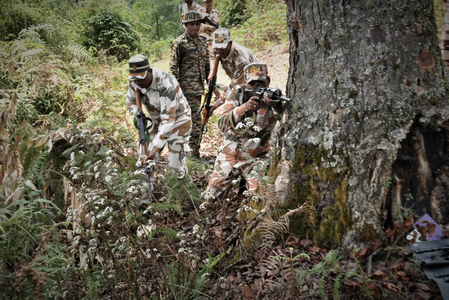
New Delhi, Aug 3 (IANS) In the years to come, grey zone warfare will continue to shape the security challenges that India faces both from China and Pakistan. When it comes to India, both Pakistan and China prefer grey zone warfare as it operates below the threshold of an open conflict.
The messages are sent across, and national objectives are achieved without engaging in a full-fledged war. Moreover, such warfare also gives these countries the deniability factor.
When it comes to grey zone warfare, China has had a calculated approach, as its major focus has been on expansion. Pakistan, on the other hand, has relied on ideological warfare and creating instability in India.
China has indulged in the salami-slicing strategy whereby it expands its control in disputed territory. Such tactics do not immediately provoke military action. Another strategy that China has indulged in is creating heavy dependence on trade, apart from offering loans and investments to exert influence.
However, one of the major dangers is cyber and information warfare.
China, in a bid to weaken its adversaries, has hacked Indian defence and infrastructure systems. It has also spread misinformation to manipulate the perception of the public.
China has also been using militia groups instead of the regular military forces, especially in disputed regions. It also funds political parties, media organisations and academic institutions to set a narrative against India. All these are aimed at reducing India’s influence by keeping the country distracted at the border.
Pakistan, on the other hand, has unfurled in ideology, proxy warfare and the Kashmir dispute. Since it has made terror a state policy, Pakistan does not mind playing with its own stability and prefers to harm India instead. Pakistan has for years promoted extremist narratives, while also encouraging separatism in India. It has also radicalised the youth of Kashmir through propaganda that it runs on social media. Pakistan has also tried to weaken India’s global standings through sustained cyber-attacks and fake news. One of the primary examples of this is discrediting India’s actions in Kashmir and Punjab.
Pakistan has always cited escalation between the two nuclear states to deter India. However, Operation Sindoor has busted that narrative. The nuclear doctrine has often been used to engage in low-intensity conflicts, as it fears that a large-scale retaliation is something it cannot handle.
Cross-border terror and infiltration have been used with the belief that India will not escalate matters.
Another worry for India is that now Pakistan and China are coordinating with each other, although their grey zone strategies are different. Pakistan has the support of China both diplomatically and militarily.
Further, China’s investments in the China-Pakistan Economic Corridor project have strengthened Pakistan to engage in grey zone tactics against India.
India’s national security planners feel that there has to be a change in strategy to counter such warfare. India will have to strengthen cyber defences and Intelligence networks to counter misinformation campaigns.
The religious and ethnic diversity is a hindrance as a multi-ethnic society is vulnerable to external manipulations.
Countering radicalisation attempts and improving stability internally are also important.
Operation Sindoor has, however, been a turning point where Pakistan is concerned, as India adopted a new and provocative military approach.
–IANS
vicky/dpb