Radio Brisvaani

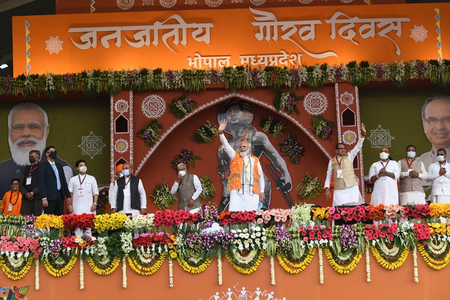
Ahmedabad, Nov 15 (IANS) As Prime Minister Narendra Modi reached Gujarat for the celebrations of Tribal Pride Day (also known as Janjatiya Gaurav Diwas), people in the state rejoiced, saying he has offered tribal communities not only compassion but also dignity, opportunity, and a pathway to self-reliance.
His long association with Janjatiya families began long before he became Prime Minister and even before his entry into high office, as the Modi Archive took to X and highlighted that his journey started in the small tribal villages of Gujarat rather than in political corridors.
As a young pracharak, Narendra Modi spent years among tribal households in Sabarkantha, Baroda, and Dang, living with families, sharing their meals, and witnessing their struggles closely.
During the severe droughts of the 1980s, he helped ensure the delivery of food and water to tribal villages cut off from aid, urging volunteers to replace lavish festivities with meaningful gestures such as supporting the education of a tribal child.
His address at a Vanvasi Kalyan Ashram event in Silvassa, where he drew from nearly 50 books on tribal heritage, left then President Zail Singh notably impressed.
Later, as the BJP’s State General Secretary, he guided emerging tribal leaders and released Gujarat’s first Tribal Haq Patra in 1995, which focussed on housing, healthcare, and dignity for indigenous communities.
These early experiences shaped his belief that tribal families needed more than compassion, pushing him to work towards ensuring dignity and self-reliance for every Janjatiya household.
Narendra Modi’s dedication to tribal welfare remained evident as soon as he became Chief Minister. Following the devastating 2001 Kutch earthquake, he chose to spend his first Diwali in Chobari, a tribal village badly hit by the disaster, indicating where his attention lay.
He later applied lessons from his pracharak years to governance through the Vanbandhu Kalyan Yojana in 2007 and the Chief Minister’s 10-Point Programme, among India’s earliest mission-mode development models aimed at uplifting tribal communities by expanding education, healthcare, irrigation, and electricity access to remote areas with real-time monitoring.
He recognised the barriers tribal children faced in accessing higher education, recalling that “from Umargam to Ambaji, there wasn’t a single science school for Class 12.” His administration built the first such institutions, expanded vocational training, and created hostels and teacher training programmes.
By the early 2000s, tribal schools in Gujarat were incorporating lessons on sustainability, from biogas plants to water harvesting and solar energy. Speaking in Dahod, the then Chief Minister said, “We gave importance to education because we care for the tribal communities, their youth and their future,” adding that tribal students were going abroad to study and that some had become pilots.
To Narendra Modi, true empowerment meant combining livelihood opportunities with ownership. His government promoted bamboo-based livelihood projects for Kotwalia artisans, backed integrated dairy expansion, and introduced mechanised farming that eased the workload of tribal farmers.
He strengthened the implementation of the Forest Rights Act of 2006 and handed over land allotment letters personally in five districts of south Gujarat, including Vansda, giving families the right to cultivate forest land.
He pledged that tribals would no longer fall prey to intermediaries, saying the state had offered land, water, and electricity to farmers. At the event, he said, “Tribals have been fighting to get ownership rights of forest land for years. The state government collected proof through the latest technology and ordered a reassessment of the rejected application. The state government gave a nod to the 22,000 applications that were rejected.”
During his Gujarat years, he emphasised that connectivity was the foundation of dignity. His administration launched an extensive road-building push, ensuring that even villages with fewer than 250 residents had all-weather access.
Alongside roads, he integrated remote tribal pockets with economic centres by expanding irrigation, power supply, and drinking water infrastructure across tribal belts.
Modi Archive noted that he also prioritised healthcare early in his tenure. Initiatives such as the Doodh Sanjivni Yojana in 2006–07 supplied fortified milk to schoolchildren, while the Chiranjeevi Yojana of 2005 supported safe motherhood, routine check-ups, and critical surgeries.
Gujarat conducted early drives to combat sickle cell anaemia and leptospirosis, years before they became part of national health agendas. This early foundation later matured into the National Sickle Cell Anaemia Elimination Mission in 2023, which has already screened more than six crore people.
“If today’s generation becomes healthy, it guarantees the health of their children,” PM Modi had said.
In 2011, Gujarat achieved a milestone when Ganpat Vasava, a legislator from a tribal family, became Speaker of the State Assembly. Narendra Modi called it “a rare and unprecedented event” and praised lawmakers for setting “a high tradition in parliamentary democracy”. His concept of tribal empowerment extended beyond welfare to representation, dignity, leadership, and cultural pride.
In 2003, he inaugurated the Tribal Martyrs’ Memorial at Palchitriya in Sabarkantha to honour 1,200 forest dwellers who fought British forces in 1922. Revisiting the site in 2012, he described it as “a living tribute to the indomitable spirit of those who refused to bow to tyranny”.
As Prime Minister, he expanded this legacy through Tribal Freedom Fighter Museums and Janjatiya Gaurav Diwas, ensuring that stories of India’s earliest defenders of freedom reach future generations.
He also played a key role in elevating Droupadi Murmu as India’s first tribal President, describing it as a landmark for true social representation.
What began in Gujarat as a series of experiments in school reform, water access, nutritional programmes, bamboo livelihoods, and microcredit initiatives has evolved into a national model for inclusive development.
The country’s flagship programmes for tribal progress today, including PM-JANMAN, Dharti Aaba Abhiyan, the Sickle Cell Mission, Van Dhan, and Eklavya schools, follow the same template of targeted, measurable, and dignity-driven governance.
As the nation marks Janjatiya Gaurav Varsh and the 150th birth anniversary of Birsa Munda, the legacy of courage and self-respect upheld by tribal icons remains central.
For many, Narendra Modi’s policies reflect a leader who did not need political calculations to connect with tribal communities but instead believed they deserved the same dignity as every Indian.
His political journey — from a pracharak in Gujarat’s tribal hamlets to rebuilding lives after an earthquake and eventually safeguarding the confidence of millions of tribal families — continues to define his approach to governance across India.
–IANS
sd/rad