Radio Brisvaani

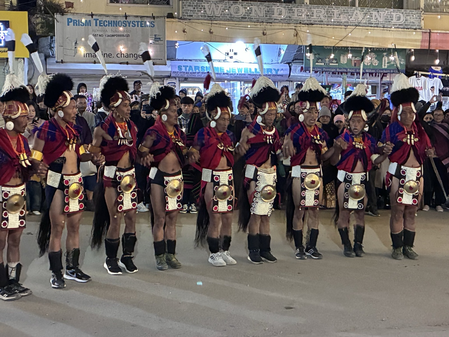
Kohima, Dec 4 (IANS) Traditional dances, indigenous songs, and customary performances mesmerised spectators, including foreign tourists, on the fourth day of the 10-day Hornbill Festival on Thursday at the Naga heritage village in Kisama.
Marking the 4th day of the Hornbill Festival 2025, the cultural show took place at Unity Plaza at Naga Heritage Village, Kisama, around 12 km south of the state capital Kohima.
The Thursday’s programme was hosted by Metsubo Jamir, Minister for Rural Development & SIRD, and co-hosted by Mhathung Yanthan, Advisor for Agriculture.
Special guests included Aloke Singh, Managing Director of Air India Express, and Surabhi Varma Garg, Principal Chief Commissioner of Income Tax (NER), Guwahati. The day’s cultural line-up showcased a vibrant array of traditional performances from various Naga tribes.
The Konyak cultural troupe presented Alea-Boa, a dance associated with the Aoleang festival, celebrated after the sowing season to mark the New Year. The Sumi cultural troupe performed Aphilo Kuwo, a traditional warrior dance recalling the valour of victorious fighters during the headhunting era.
The Kuki cultural troupe showcased Khulkon Lam, depicting the legendary migration of the Chin-Kuki-Mizo people from the subterranean world to the surface in search of fertile land, while the Phom cultural troupe presented Moolum Shou, a powerful song expressing emotions of vengeance and hatred after victory over enemies.
The cultural troupes belonging to Rengma, Pochury, Tikhir, Lotha, Sangtam, Yimkhiung, Zeliang, Angami, Ao, Chang, Khiamniungan, Garo, and Chakhesang communities performed different traditional performances.
Concluding the line-up, the Kachari cultural troupe performed Swdwmsri Mwsanai, symbolising the mythical mastery of all folk dances, reflecting women’s aspiration to preserve cultural knowledge and heritage. Meanwhile, at the inaugural ceremony on December evening, Chief Minister and host of the 10-day (December 1-10) festival, Neiphiu Rio, had said that the Hornbill Festival is an expression of the Nagas’ way of life; it represents the unity and oneness of the Nagas. He added that it signifies the rich legacy, living traditions and respect for the ancestors.
Over 86 per cent of the state’s two-million population (2011 Census) belongs to tribal communities.
Nagaland has 17 major tribes and numerous sub-tribes, each with its own rich cultural heritage, traditional dances, music, attire and customs. Six countries — Austria, France, Ireland, Malta, Switzerland and the United Kingdom — are the partner countries for this year’s 10-day 26th edition of the Hornbill Festival, while reinforcing regional cooperation. Arunachal Pradesh is the state partner.
–IANS
sc/dan