Radio Brisvaani

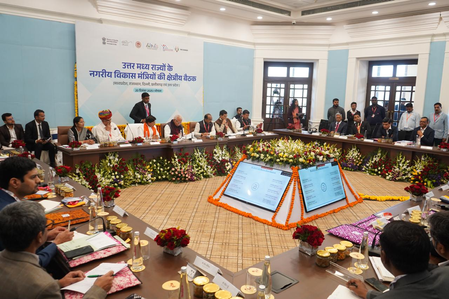
Bhopal, Dec 20 (IANS) Union Minister for Housing and Urban Affairs Manohar Lal Khattar on Saturday inaugurated the Bhopal Metropolitan Region (BMR), a major initiative to manage rapid urbanisation around Madhya Pradesh’s capital.
The sprawling region, covering approximately 9,600 square kilometres and encompassing parts of five districts – Bhopal, Sehore, Raisen, Vidisha, and Rajgarh (including Biaora) – aims to enable coordinated development planning and arrest uncontrolled urban sprawl.
Speaking at the event, held alongside the Bhopal Metro inauguration, Minister Khattar emphasised that the BMR would reduce pressure on core urban areas, allowing the state government to effectively implement development schemes.
“The Central government will extend all possible cooperation to ensure integrated growth,” he assured, highlighting the framework’s role in delivering infrastructure, housing, and services more efficiently.
The BMR, established under the Madhya Pradesh Metropolitan Planning and Development Act, 2025 (passed earlier this year), represents the expanding footprint of Bhopal, famously known as the “City of Lakes” for its abundant water bodies.
Speaking on the occasion, Chief Minister Mohan Yadav said this is another step and the inauguration of various development projects which will be developed with an investment of Rs 5800 crore in a phased manner, with BMR entire state will have booming economic activities.
The 2011 Census recorded the Bhopal Urban Agglomeration at about 1.88 million residents; current estimates for the broader area stand at around 2.7 million, with the metropolitan region housing approximately 3.5 million people.
Projections plan for sustainable accommodation of up to 6 million in the coming decades.
Governed by a Metropolitan Region Development Authority (MRDA) created recently, and the Metropolitan Planning Committee (MPC) – both chaired by the Chief Minister – the BMR prioritises coordinated land use, infrastructure expansion, industrial corridors (such as linking Mandideep), environmental conservation of lakes and catchment areas, and protection of heritage sites like Sanchi and Bhimbetka.
Economically, Bhopal remains an administrative, educational, and emerging IT hub.
The region’s connectivity received a significant boost today with the simultaneous inauguration of the Bhopal Metro’s priority Orange Line corridor (6-7 km from Subhash Nagar to AIIMS), featuring modern, eco-friendly facilities.
This metropolitan framework marks a transformative step, positioning Bhopal as a planned, sustainable, and resilient urban centre while balancing rapid growth with green spaces and cultural preservation.
–IANS
sktr/dan