
Radio Brisvaani

New Delhi, Dec 25 (IANS) India stepped up its efforts to forge new economic and trade partnerships this year, amid growing economic uncertainties in global markets, triggered by the US tariff turmoil.
Three major free trade agreements signed by India with the UK, New Zealand and Oman — and the ongoing talks with the European Union (EU) — will not only enhance trade but also increase competitiveness, attract quality foreign investment, and provide greater access to high-end technologies and markets.
India has been able to secure fair and equitable deals in these free trade agreements which provide greater access for India’s manufactured goods and skilled professionals in these markets. At the same time, the government has succeeded in protecting India’s agricultural sector from foreign competition to ensure that the livelihood of the country’s farmers is not adversely impacted.
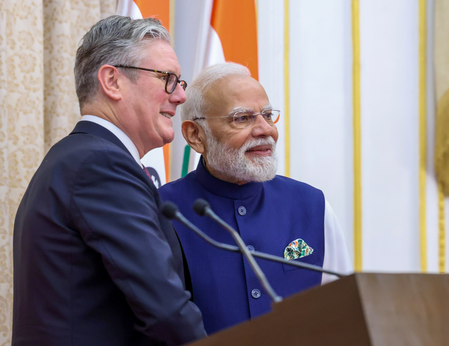
The country concluded a Comprehensive Economic and Trade Agreement (CETA) with the United Kingdom in July this year which provides an unprecedented duty-free access to 99 per cent of India’s exports to the UK, covering nearly 100 per cent of the trade value, benefiting labour-intensive sectors such as textiles, leather, marine products, gems, engineering goods, chemicals, and auto components.
Notably, the agreement goes beyond goods and addresses services, a core strength of India’s economy. India exported over US$ 19.8 billion in services to the UK in 2023, and CETA promises to expand this further.
Additionally, in a first by the UK, mobility for professionals across IT, healthcare, finance, and education is being eased with CETA. This offers streamlined entry for contractual service suppliers, business visitors, intra-corporate transferees, independent professionals.
India’s trade and economic partnership agreement with the EFTA countries- Switzerland, Norway, Iceland, and Liechtenstein, which was signed in 2024, was operationalized in October this year. The agreement improves market access for over 99 per cent of India’s exports to the region including pharmaceuticals, engineering goods, and services. The four countries have also agreed to invest USD 100 billion in India, which will result in the creation one million jobs.
The India and New Zealand free trade agreement (FTA) signed this month will ensure Zero duty on 100 per cent of India’s exports and will benefit farmers, MSMEs, workers, artisans, women-led enterprises, and youth, while providing immense opportunities for labour-intensive sectors such as textiles, apparel, leather, and footwear.
Sectors like engineering and manufacturing, automobiles, electronics, machinery, plastics, pharmaceuticals & chemicals will also stand to benefit.
The agreement also provides a significant boost to investments, with New Zealand committing to facilitating $20 billion in FDI into India over 15 years, targeting manufacturing, infrastructure, services, innovation and job creation.
The FTA creates new opportunities for India’s services sector, spanning IT & ITeS, finance, education, tourism, construction, and other areas. New Zealand’s first-ever annexes on health, traditional medicine, student mobility, and post-study work, open up unprecedented avenues for Indian professionals and students.
India and Oman also signed the Comprehensive Economic Partnership Agreement (CEPA) in December during the second day of Prime Minister Narendra Modi’s visit to Muscat which opens up new economic opportunities in the Gulf region.
The CEPA secures unprecedented tariff concessions for India from Oman. Oman has offered zero-duty access on 98.08 per cent of its tariff lines, covering 99.38 per cent of India’s exports to Oman. All major labour-intensive sectors including Gems & Jewellery, Textiles, leather, footwear, sports goods, plastics, furniture, agricultural products, engineering products, pharmaceuticals, medical devices, and Automobiles receive full tariff elimination.
The Services sector, a strong driver of India’s economy, will also see wide-ranging benefits. Oman’s substantial global services imports amounting to USD 12.52 billion, with the share of India’s exports in Oman’s global imports basket as 5.31 per cent, indicating significant untapped potential for Indian service providers.
The agreement features a comprehensive and forward-looking services package, with Oman extending substantial commitments across a broad spectrum of sectors including computer related services, business and professional services, audio-visual services, Research and Development, education and health services.
“More and more countries want to deepen relations with a resurgent, strong, and aspirational India as the country’s growing consumer demand, fast economic growth, and focus on sustainable development are creating major trade opportunities,” according to Commerce and Trade Minister Piyush Goyal.
–IANS
sps/na