Radio Brisvaani

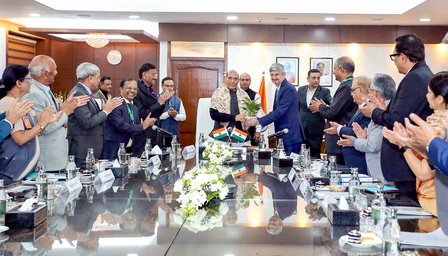
New Delhi, Jan 1 (IANS) As the curtains came down on ‘Year of Reforms 2025’, the Ministry of Defence under Rajnath Singh recorded significant progress in implementing wide-ranging reforms aimed at strengthening jointness, enhancing defence preparedness, promoting self-reliance and improving welfare delivery mechanisms, an official said on Thursday.
The Defence Minister steered reforms, adopting a whole-of-government approach towards building a modern, integrated and future-ready defence ecosystem.
During 2025, the Defence Acquisition Council approved capital acquisition proposals worth over Rs 3.84 lakh crore since January 2025 to enhance the country’s defence readiness, with a focus on modernisation through indigenisation.
In the Financial Year 2025-26 till the end of December 2025, the Ministry of Defence signed capital contracts amounting to Rs 1.82 lakh crore for the modernisation of the Armed Forces, said the MoD official in a statement.
The Ministry also fared well in terms of expenditure. It achieved 80 per cent expenditure under the Capital Acquisition Budget by the end of December 2025. The allocation under this is spent on the modernisation of the Armed Forces. The overall capital expenditure of MoD has also reached 76 per cent, which includes expenditure on Infrastructure, land and R&D in addition to capital acquisition.
The MoD said in a statement that to promote greater indigenisation in defence and secure supply chains, private sector participation has been increased.
This includes streamlining defence manufacturing licenses, mapping the competencies of MSMEs, and preparing Market Intelligence Reports to enhance demand-supply analysis in defence procurement.
Additionally, testing and trial infrastructure lab facilities are being shared with the private sector, and 25 per cent of defence research grants are also being allocated to them, along with academic institutions and MSMEs, to encourage innovation and strengthen collaboration in the defence sector.
Procurement processes have been streamlined to reduce timelines, including Simplification of the iDEX manual, Rationalisation of defence export permissions, Revamping of the Defence EXIM Portal, Simplification of Technology Transfer policy and Decentralisation through revised Delegation of Financial Powers and Procurement Manuals, according to the Defence Procurement Manual 2025, implemented from Nov 1, 2025.
During the last year, review and revision of the Defence Acquisition Procedure 2020 were undertaken by the Ministry. The move helped in the encouragement of Foreign Direct Investment in defence, Enhanced engagement with friendly countries, Defence Lines of Credit, including Bharat Maitri Shakti, and Rationalisation of restricted distance norms near defence establishments.
The formation of an Export Promotion Body, Implementation of Quality Assurance 4.0 and Industry 4.0 in DPSUs and Establishment of a National Integrated Test Laboratory for defence platforms were some measures aimed at better Defence Production and Quality Enhancement.
In the area of jointness and future Preparedness, the establishment of the Joint Operations Control Centre, promulgation of Vision 2047 for the Armed Forces, Creation of a Future Operations Analysis Group, Promotion of joint training programmes and Finalisation of the Integrated Capability Development Plan were the key measures.
The steps taken in this direction bore fruit during the planning and execution of Operation Sindoor, said an official statement.
In 2025, the deployment of the Tri-Service Geographical Information System, review and Harmonisation of policies, SOPs and Tactics, Techniques & Procedures for Tri-service uniformity, Expansion of women’s roles in combat and leadership positions, Promotion of military tourism and Preparation of a long-term roadmap for operational infrastructure and accommodation have been completed.
To improve the delivery of medical cover for veterans and their dependents under ECHS, pan-India doorstep delivery of medicines to 70-year-plus Ex-servicemen (ESM) with infirmity was introduced, authorised local chemist limits were doubled, and eSeHAT tele-medicine consultation was introduced.
Other measures included AYUSH treatment at ECHS and creation of stress management facilities, it said.
The Common drug list was enhanced, along with the upgradation of some ECHS polyclinics; creation of some new polyclinics is underway.
Enhancement of welfare grants to ESM and their dependents, including Penury, Education and Marriage grants, was implemented.
Also, 31.69 lakh defence pensioners were onboarded on SPARSH, India’s largest digital pension platform. Out of 6.43 lakh discrepant cases that were migrated from previous systems, 6.07 lakh have been normalised without affecting pensioners’ entitlements.
The sustained reform momentum during the ‘Year of Reforms 2025’ has strengthened India’s defence preparedness and institutional efficiency. These reforms are not isolated initiatives, but part of a continuous process to build a modern, integrated and self-reliant defence ecosystem capable of safeguarding the nation’s security interests in the decades ahead, said an MoD official in a statement.
–IANS
rch/dan