Radio Brisvaani

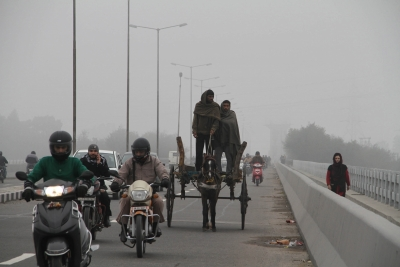
Jammu, Jan 14 (IANS) Jammu recorded 7.4 degrees Celsius as its maximum temperature on Wednesday, which is 10.1 degrees less than normal and lower than the maximum temperature recorded anywhere in the Kashmir Valley in the day.
“7.4 degrees Celsius as the maximum temperature is the 4th lowest ever recorded in Jammu,” local Met Department Director Mukhtar Ahmad told IANS.
“The maximum temperature was 5 degrees Celsius in January 1986, 6.7 degrees in 2013 and 7.1 degrees in 2016,” he added.
Srinagar city had a maximum of 13.3 degrees Celsius, Pahalgam 10.6, and Gulmarg 8.2 degrees Celsius, the official said.
Jammu city had 4 as the minimum temperature on Wednesday. With the gap between the minimum and the maximum temperature narrowing down to barely over 3 degrees, people living in Jammu city said they are witnessing unprecedented cold this January.
“I am wearing a ‘pheran’ (tweed over garment) and holding a ‘kangri’ (Earthen fire-pot woven in willow wicker filled with live charcoal) under the pheran. I have been holding on to the Kangri for the entire day today”, said Manzoor Ahmad Bhat, a resident of Roop Nagar area in Jammu city.
Bhat has been spending the winter months in Jammu for the last three decades.
Originally belonging to the Valley, Bhat has the ‘luxury’ of the Pheran and the Kangri, which is unknown to the original residents of Jammu city.
Fog continued throughout the day in Jammu city on Wednesday in varying degrees, adding to the chill factor.
In contrast to the overhanging cloud cover in Jammu city, Srinagar had bright sunshine throughout the day, and most people came out to warm themselves up in the winter sun.
Nights have, however, been very cold in the Valley as the minimum temperature drops during the night due to clear skies.
In fact, the absence of this winter’s first snowfall in the plains of the Valley is causing a lot of concern to the people in Kashmir.
The 40-day-long period of harsh winter cold called the ‘Chillai Kalan’ started on December 21 and will end on January 30.
Kashmir traditionally has its bountiful snowfall during the Chillai Kalan, and it is the heavy snowfall during the Chillai Kalan that replenishes the perennial water reservoirs in the mountains.
These perennial water reservoirs sustain all the water bodies of J&K during the hot summer months.
The Met Department said a feeble Western Disturbance is likely to cause some precipitation in J&K on January 16, but it is unlikely to bring snowfall in the plains of the Valley.
However, two back-to-back Western Disturbances between January 20 and January 24 give some hope of this winter’s first snowfall in the plains.
Even the snowfall in the mountains so far hasn’t been heavy, and the fact that the Srinagar-Leh highway passing through the Zojila Pass is still open for traffic proves that a heavy snowfall is still to occur in the higher reaches of J&K.
–IANS
sq/vd