Radio Brisvaani

Guwahati, Jan 20 (IANS) The Centre for Wildlife Rehabilitation and Conservation (CWRC) has so far rescued and handled 7,397 wild animals belonging to 357 species in Assam’s Kaziranga National Park and Tiger Reserve (KNPTR), officials said on Tuesday.
The CWRC was established in 2002 as a collaborative initiative of the Assam Forest Department, the Wildlife Trust of India (WTI) and the International Fund for Animal Welfare (IFAW).
KNPTR Field Director Sonali Ghosh said that CWRC primarily focuses on rescuing flood-distressed and orphaned wild animals, especially during the annual monsoon floods in Kaziranga, whose vast areas are submerged during the four-month-long monsoon period.
The centre provides emergency veterinary care, hand-raises orphaned animals when required and rehabilitates fit individuals back into the wild through scientifically established protocols, including the use of pre-release enclosures.
She said that of the 7,397 animals rescued and handled so far, approximately 4,490, about 65 per cent, have been successfully released back into forest habitats after treatment. These include 25 hand-raised greater one-horned rhinoceroses, of which 23 were released in Manas National Park and two in Kaziranga. At present, CWRC houses three rhino calves.
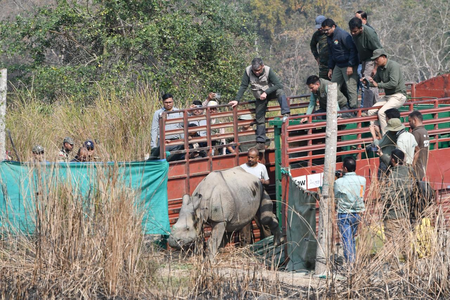
Of these, two male rhinos aged around four to five years were successfully translocated on Tuesday to Kaziranga National Park. The translocation followed internationally accepted conservation protocols.
After obtaining the requisite permissions from the Chief Wildlife Warden, Assam, under the Wildlife (Protection) Act, a site selection committee was constituted to identify suitable locations for the pre-release enclosures.
The rhinos were subsequently moved to these enclosures, where they will be habituated to wild conditions before their final release into the park. The translocation operation was overseen by a team of veterinarians, while officials of Kaziranga National Park, led by Field Director Sonali Ghosh, accompanied and supervised various aspects of the process.
Officials said the rhino transfer is a testimony to the scientific wildlife management and established rehabilitation protocols followed at KNPTR, ensuring that rescued animals, particularly the iconic greater one-horned rhinoceros, are allowed to return to their natural habitat even after experiencing severe stress due to calamities such as floods.
Kaziranga National Park and Tiger Reserve, India’s seventh UNESCO World Heritage Site, is home to the famed ‘Big Five’.
As per the latest estimates, the park shelters 2,613 greater one-horned rhinoceroses (2022 census), 104 Bengal tigers (2022), 1,228 Asian elephants (2024), 2,565 wild water buffaloes (2022) and 1,129 eastern swamp deer (2022).
Spread across the districts of Golaghat, Nagaon, Sonitpur and Biswanath, the park generated revenue of over Rs 10.90 crore in 2024-25 and more than Rs 8.81 crore in 2023-24.
The KNPTR comprises three forest divisions – Eastern Assam Wildlife Division (Bokakhat), Biswanath Wildlife Division (Biswanath Chariali) and Nagaon Wildlife Division (Nagaon).
–IANS
sc/dan