Radio Brisvaani

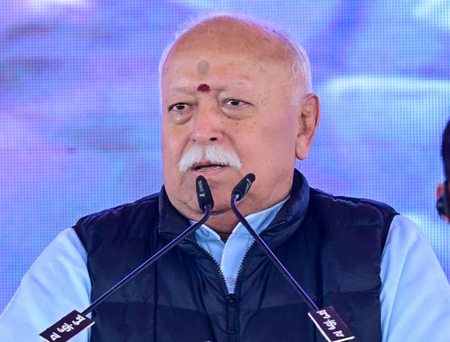
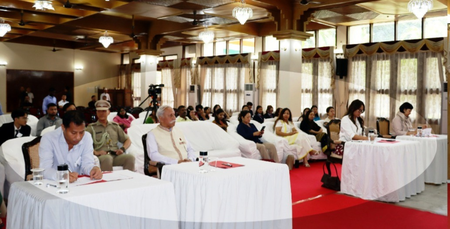
Jaipur, Jan 22 (IANS) A grand and solemn programme was organised on the eve of the 162nd Maryada Mahotsav (Festival of Decorum) at Chhoti Khatu in Rajasthan’s Nagaur district on Thursday.
The event was held in the holy presence of Acharya Mahashraman, with the intellectual address delivered by Rashtriya Swayamsevak Sangh (RSS) Sarsanghchalak Mohan Bhagwat.
In his address, RSS chief Mohan Bhagwat said that India has always guided the world through the practice of decorum and righteous conduct. Since ancient times, he said, people have turned to saints for guidance on values and discipline.
“We learn the use of the stick in Sangh shakhas, but we go to saints to understand why it should be carried, when it should be used, and what its limits are,” he said, stressing that conduct, not mere words, inspires society.
Bhagwat said that the finest individuals in Indian society have always lived by these principles, becoming role models for others.
Pursuit of wealth alone, he noted, is not part of India’s tradition. Even those who earn wealth are encouraged to donate and serve society.
Charity and service, he said, are deeply ingrained in Indian culture.
Emphasising the pursuit of truth, Bhagwat said that truth is infinite, but the modern world has limited itself to material and sensory knowledge.
While people appear different, he said, at their core all are one, and living with the belief that “everyone is our own” naturally brings discipline and compassion.
He said that values such as truth, non-violence, celibacy, non-stealing, and non-possession have been deeply understood and practised in India.
Dharma, he added, is the principle that upholds righteousness and balance, and not all problems of life can be solved through law alone – many require the guidance of Dharma.
Referring to the global scenario, Bhagwat said that many nations act solely in self-interest, but India has consistently followed a path of concern for all.
He cited India’s humanitarian assistance during global crises as an example of Dharma in action. On environmental balance, he contrasted Western agricultural practices aimed at eradicating pests with the Indian approach of maintaining ecological balance through controlled pest management.
This, he said, reflects India’s broader philosophy of harmony rather than excess. Addressing the gathering, Acharya Mahashraman, while quoting a Sanskrit verse, said that wise words are precious like gems, though ignorant people may fail to recognise their value.
A true guru, he said, imparts words of welfare and right knowledge, guiding society in the correct direction. In India, he added, scriptures, sacred texts, and the teachings of saints have always enhanced human understanding and capability, providing direction in life.
He explained that the tradition of Maryada Mahotsav dates back to Magha Shukla Saptami, when the first ritual was initiated by the first Guru, while the festival itself was formally established by the fourth Guru, Dayacharya Ji. Discipline and decorum, he said, are essential in both monarchy and democracy.
Acharya Mahashraman said that peace is the ultimate objective for humanity. However, when the language of peace is not understood, firmness becomes necessary. Non-violence should remain the fundamental policy of the nation, and aggression should never be initiated. Yet, if national security is threatened, the armed forces must take up arms to protect citizens.
“For saints, absolute non-violence is essential, but for householders and the state, the use of force may become a necessity for protecting the nation,” he said, adding that strictness may sometimes be required for the sake of goodness and lasting peace.
Earlier, Mansukh Bhai Sethia, chairman of the organising committee, welcomed guests and devotees and outlined the significance of the programme.
Senior RSS functionaries, including Nandlal Babaji, Rajasthan regional secretary Jaswant Khatri, regional organiser Nimbaram, Jodhpur provincial head Hardayal, Didwana district head Ram Avtar Sarraf, and Nagaur district head Mukesh Bhati, along with representatives of various social organisations and a large number of devotees and women, were present.
Special emphasis was laid on ensuring that no food was wasted during the programme, a discipline strictly followed by devotees, including those who had travelled from outside Rajasthan.
–IANS
arc/dan