Radio Brisvaani

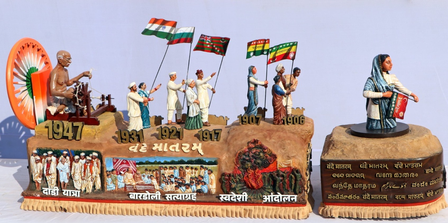
New Delhi, Jan 26 (IANS) Gujarat’s tableau drew wide attention at the 77th Republic Day parade on Kartavya Path on Monday, as it presented a chronological depiction of the evolution of the Indian National Flag, aligned with the national theme “Swatantrata Ka Mantra: Vande Mataram”.
The presentation coincided with the completion of 150 years of “Vande Mataram”, a song that became prominent during India’s freedom struggle and remains closely associated with the ideals of independence and self-reliance.
The tableau started with a powerful representation of freedom fighter Madam Bhikhaiji Cama, a native of Navsari in Gujarat, shown holding the flag inscribed with “Vande Mataram” that she prepared and unfurled on foreign soil, an act carried out in Paris in 1907.
The same flag was later displayed at the Indian Socialist Conference held in Stuttgart, Germany.
Beneath the sculpture, the words “Vande Mataram” were inscribed in several Indian languages recognised by the Constitution, underscoring its pan-Indian resonance.
The central portion of the tableau traced the journey of the National Flag through key phases of the freedom movement. It depicted the earliest flag bearing “Vande Mataram” that was hoisted during the Swadeshi movement at Parsi Bagan in Kolkata, an event that took place in 1906.
This was followed by the representation of the flag unfurled by Madam Cama in Europe a year later.
The narrative then moved to the Home Rule Movement, showing the flag associated with Annie Besant and Bal Gangadhar Tilak, unveiled in 1917.
The tableau further portrayed the design presented to Mahatma Gandhi by Pingali Venkayya at Vijayawada, an episode from 1921, and the subsequent modified version featuring the charkha that came close to acceptance in 1931.
The sequence concluded with the depiction of the Tricolour bearing the Ashoka Chakra, which was formally adopted by the Constituent Assembly shortly before Independence, on July 22, 1947.
The concluding segment featured a sculpture of Mahatma Gandhi with the charkha alongside a prominent Dharma Chakra, symbolising the ideals of swadeshi and self-reliance.
Cultural performers accompanied the tableau with renditions of “Kasumbi No Rang”, a composition by Gujarati poet Jhaverchand Meghani, adding rhythm and visual energy to the display.
Elsewhere in the parade, the CRPF men’s contingent was led for the first time by Assistant Commandant Simran Bala, 26, who pursued her higher education in Gujarat and graduated from the Government Women’s College in Gandhinagar before joining the force.
Another notable first was the participation of animals described as ‘Silent Warriors’, including Mongolian Bactrian camels, mules deployed in the Siachen Glacier, birds of prey and military dog squads.
The parade featured 30 tableaux from states, Union Territories and central government departments, with nearly 2,500 artists performing.
The ceremony began with tributes from Prime Minister Narendra Modi, Defence Minister Rajnath Singh and heads of the Indian Armed Forces at the National War Memorial.
Monday’s event was also attended by European Commission President Ursula von der Leyen and European Council President Antonio Costa as Chief Guests.
–IANS
mys/dan