Radio Brisvaani

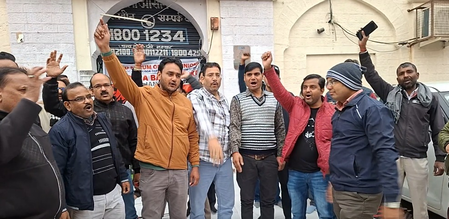
New Delhi, Jan 27 (IANS) Bank employees across the country went on strike on Tuesday to protest for their demands, including the immediate implementation of a five-day work week in the sector, leading to widespread disruption of banking services, including cash deposits, withdrawals, cheque clearances and other routine transactions.
The nationwide strike was called by the United Forum of Bank Unions (UFBU).
In Gujarat’s Vadodara, employees of nationalised banks joined the strike in large numbers. Protesters said that memoranda regarding the demand for a five-day work week had been submitted to the government on multiple occasions, but no concrete steps had been taken so far, forcing employees to resort to a strike. Due to the agitation, customers faced inconvenience as several bank branches remained closed or operated with minimal staff.
A protesting employee said: “More than eight lakh bank employees across India are participating in today’s strike. Our demand for a five-day banking week has been pending since 2015. Institutions such as the LIC, state governments and the Central government already follow a five-day work week. We were assured that banks would also shift to this system, but nothing has been implemented yet.”
In West Bengal’s Cooch Behar, bank employees’ unions held protests in front of the State Bank of India and other banks, reiterating their demand for a five-day work week.
A protester said: “Banks across the world and most offices in India, whether under the Central or state governments, function for five days a week. From the Reserve Bank of India to NABARD and LIC, all follow a five-day schedule, but nationalised and private banks have been left out. We had an agreement with the Indian Banks’ Association (IBA) on this issue.”
Similar scenes were witnessed in Murshidabad district, where banks and ATM branches in Berhampore and other areas remained closed. Posters highlighting the demands of the bank unions were displayed outside bank premises.
A protester said the demand for five-day banking had been pending for nearly three years and was repeatedly postponed by the government.
“The government keeps saying it will be implemented soon, but nothing has happened so far. That is why we are protesting today,” he said.
In Uttar Pradesh’s Ghazipur district, over 10,000 bank employees from nearly 250 banks joined the nationwide strike, disrupting transactions worth over Rs 150 crore. Banking activities across the district came to a standstill, causing inconvenience to customers and businesses alike.
In Lucknow, All India Bank Officers’ Confederation (AIBOC) Senior Vice-President Ramnath Shukla said: “There is only one demand, and that is five-day banking. This demand has been ongoing for the past ten years. When the second and fourth Saturdays were declared holidays, it was promised that the remaining Saturdays would also be closed in the next settlement. Other departments were given five-day working without even demanding it.”
Indian Bank employee Anshika Singh Visen said: “In the last bipartite settlement, it was decided that bankers would be given five-day banking, with work from Monday to Friday and weekends off. However, while other proposals were accepted, the five-day banking proposal was not implemented.”
In Chandigarh, the one-day strike also affected normal banking operations. Bank employees staged protests outside bank branches, raising slogans in support of their demand for a five-day work week.
In Chhattisgarh’s Raipur, around 25,000 bank employees from nearly 2,500 banks participated in the strike. Banking services across the state were severely affected as employees gathered in large numbers to protest and press for their long-pending demand.
In Patna, Punjab National Bank employee Dimple said the strike was not an “out-of-work” protest.
“The government had agreed under the bipartite settlement that five-day banking would be implemented within six months. However, even after two years, the demand has not been fulfilled. The RBI, the SIDBI, the SEBI, and the NABARD all function for five days. We want the same to be implemented in banks immediately,” she said.
Another PNB employee, Ritika, said: “The 12th Bipartite Settlement clearly stated that five-day banking would be implemented within six months. It has been two years since the agreement, but nothing has been done. That is why we are on strike today.”
In Rajasthan’s Dholpur, banks across the district remained completely closed, severely affecting essential services such as cash transactions, deposits, withdrawals and cheque clearances, causing significant inconvenience to the public.
–IANS
jk/vd