Radio Brisvaani

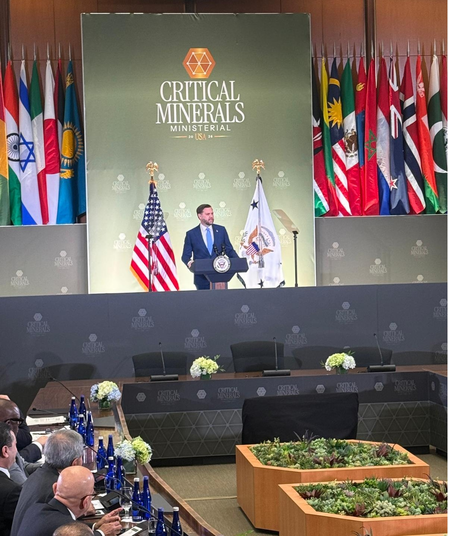
Washington, Feb 4 (IANS) US Vice President J D Vance on Tuesday urged US allies and partners to act collectively to fix what he described as a broken global market for critical minerals, warning that brittle and highly concentrated supply chains threaten economic growth and national security.
Opening the Critical Minerals Ministerial, Vance said modern economies continued to depend on “real things,” stressing that critical minerals were as essential as oil and gas for economic activity, advanced manufacturing, and defence systems.
The ministerial, one of the largest ones hosted by the United States, is being attended by over 50 countries. India is being represented by External Affairs Minister S Jaishankar.
“There is no realer thing than critical minerals,” Vance said, arguing that governments had learned “the hard way” how deeply their economies depended on stable access to these materials.
He said countries represented at the meeting together accounted for close to two-thirds of global GDP and had the capacity to make themselves “more independent, more self-reliant” if they worked together.
Vance said the current international market was failing to support domestic supply chains or long-term investment. He cited repeated instances in which mining and processing projects collapsed after sudden market flooding led to price crashes, forcing investors to pull out.
“Supply chains remain brittle and exceptionally concentrated,” he said, adding that erratic and unpredictable prices had made sustained investment nearly impossible.
He outlined the Trump administration’s broader approach to addressing those vulnerabilities, pointing to steps already taken over the past year, including domestic and international agreements, expanded public financing tools, and new efforts to stockpile minerals.
Vance also described a proposed preferential trade zone for critical minerals, built around reference prices intended to stabilize markets and protect supply chains from external disruption. He said the initiative was designed to create diverse centers of production and supply chains immune to sudden shocks, while strengthening partner countries.
“Our alliances and our friendships can really help one another,” Vance said.
Secretary of State Marco Rubio, delivering his opening remarks after Vance, echoed the call for coordinated international action and said the administration viewed critical minerals as central to both economic and national security.
“Critical minerals are vital to the devices that we use every single day,” Rubio said, noting that they power infrastructure, industry, and national defense.
Rubio said US President Donald Trump had made the issue a top priority from his first day in office, citing an executive order issued in March to accelerate permitting reform, increase domestic mining, and build reliable supply chains “both at home and abroad.”
“In October alone, the United States secured over $10 billion in critical mineral agreements across five countries,” Rubio said, pointing to existing efforts to deepen cooperation with allies and partners.
He also highlighted the Pax Silica Summit convened in December, which he said launched a partnership dedicated to building a resilient silicon supply chain capable of supporting “a new era of global prosperity.” Rubio warned that emerging technologies such as artificial intelligence would not be possible unless countries rebuilt factories and reopened mines.
Drawing on US history, Rubio recalled how rare earth discoveries at Mountain Pass, California, helped usher in the jet age, space age, and computer age before mining was neglected and supply chains were outsourced.
“We woke up and realised we had outsourced our economic security and our very future,” he said.
Rubio compared the current effort to the Washington Energy Conference held in the same room about 50 years ago, which led to the creation of the International Energy Agency during a period of concentrated global oil supplies. He said today’s discussions were aimed at advancing Critical Minerals Framework Agreements to protect every stage of production from mining to refining and manufacturing.
“This is not solely an American initiative,” Rubio said. “This must be an international global initiative with like-minded countries.”
The ministerial brought together senior officials from dozens of countries as governments seek to reduce dependence on concentrated mineral supply chains amid rising geopolitical tensions and growing demand from clean energy, defense, and advanced technology sectors.
–IANS
lkj/as