Radio Brisvaani

Hyderabad, Feb 6 (IANS) Telangana Deputy Chief Minister Mallu Bhatti Vikramarka said on Friday that Hyderabad is competing with leading global cities in terms of investments, talent, and quality of life. He also stated that the state government, led by Chief Minister Revanth Reddy, allocated ₹20,000 crore for the development of Hyderabad city within a span of just two years.
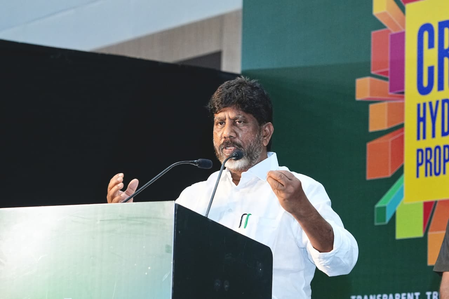
Speaking at the CREDAI Property Exhibition at HITEX, he said several works under this allocation have already been completed, while many others are currently in progress.
He claimed that such a massive allocation of funds exclusively for Hyderabad’s development has never happened before in the history of the state.
The Deputy Chief Minister informed that ₹1,950.52 crore has been allocated under the Greater Hyderabad Municipal Corporation (GHMC) limits, ₹12,500 crore under the Hyderabad Metropolitan Water Supply and Sewerage Board (HMWSSB), and ₹4,365 crore under the Hyderabad Metropolitan Development Authority (HMDA).
Vikramarka termed the merger of 27 surrounding urban local bodies with the GHMC a historic decision. Through this landmark move, uniform civic services, integrated planning, and a unified development vision within the Outer Ring Road region have become possible, he said.
“Today, Hyderabad stands as one of the fastest-growing and most investment-friendly cities in the country. This has not happened by chance. It is the result of decades of institution-building, democratic governance, and the people’s government’s commitment to inclusive development,” he said.
The Deputy Chief Minister asserted that today’s growth rests on the strong foundations laid by visionary leadership in the past, and these foundations are being further strengthened by the present government’s focus on transparency, accountability, and people-centric governance.
The merger of municipalities reflects the government’s belief that urban development must be just, balanced, and accessible to all, he said. Regardless of where people live, Hyderabad is no longer being shaped as a collection of isolated affluent areas, but as a single, integrated, and comprehensively developing metropolitan city.
He mentioned that under the Hyderabad City Innovative and Transformative Infrastructure Programme (H-CITI), works are being implemented with an investment of over ₹7,032 crore, including 45 major flyovers, underpasses, and 10 road widening projects.
He revealed that projects worth ₹1,090 crore are being undertaken around KBR Park to address traffic congestion. In the western corridor, multi-level flyovers at IIIT and Khajaguda, built at a cost of ₹837 crore, are supporting the knowledge economy, while road widening works worth ₹70 crore are underway in the western city areas.
In the northern part of the city, alternative road networks near the Army Ordnance Centre are being developed at a cost of ₹960 crore to resolve decades-old traffic problems. In eastern Hyderabad, flyovers at TKR College, Gayatri Nagar, and Mandamallamma Junction are being taken up at a cost of ₹416 crore to improve connectivity. In the southern part of the city, road widening projects worth ₹863 crore are being implemented to support rapidly expanding urban development.
These investments are reducing travel time, improving logistics, strengthening economic activity, increasing land values, and most importantly, improving the daily lives of ordinary people — students, workers, entrepreneurs, and families, he said.
He assured that Hyderabad will continue to be Telangana’s main engine for employment, innovation, and global investments, while ensuring that the benefits of development reach every section of society.
However, he emphasised that infrastructure alone does not make a great city; the true measure of greatness lies in how a city treats its people, especially the most vulnerable sections.
Keeping the year 2047 in mind, the government is preparing a comprehensive Storm Water Master Plan, particularly to benefit low-lying and backward areas, ensuring flood safety and climate resilience. Along with this, through UMTA, integrated spatial master plans, blue-green master plans, and comprehensive mobility plans are being developed to ensure orderly, environmentally responsible, and accessible growth, he added.
–IANS
ms/rad