Radio Brisvaani

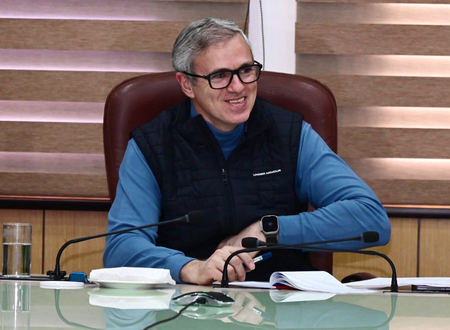
Jammu, Feb 9 (IANS) Jammu and Kashmir Chief Minister Omar Abdullah told the Legislative Assembly on Monday that his government is making all arrangements to hold elections to urban local bodies and panchayats at the earliest, but added that the post of State Election Commissioner is still vacant.
Replying to a question raised by Congress MLA Tariq Hameed Karra, Omar Abdullah said the superintendence, direction and control of the preparation of electoral rolls and the conduct of elections under the Jammu and Kashmir Panchayati Raj Act, the Jammu and Kashmir Municipal Act and the Jammu and Kashmir Municipal Corporation Act, 2000, rest with the State Election Commission (SEC).
He said the SEC is making the necessary arrangements to hold panchayat and urban local bodies elections at the earliest.
However, the Chief Minister pointed out that the position of State Election Commissioner is lying vacant at present.
He said the report submitted by the Jammu and Kashmir Local Bodies to Backward Classes Commission for determining the quota of reserved seats is under examination and that further steps will be taken accordingly.
Informing the House, the Chief Minister said the term of panchayats and block development councils (BDCs) expired on January 9, while the term of the district development council (DDC) will end on February 24.
He said the tenure of the Srinagar Municipal Corporation ended on November 5, 2023, while the term of Jammu’s civic body also ended in the same month on November 14.
The terms of all municipal councils and committees expired between October and November 2023.
He said panchayat halqas were delimited prior to the 2018 panchayat elections on the basis of the 2011 Census.
“As per the Panchayati Raj Act, fresh delimitation of panchayat halqas can be undertaken only after the publication of population figures of the general Census.
“Since no Census has been conducted after 2011, there is no proposal for fresh delimitation at present,” he said.
The Chief Minister further said that the delimitation of 77 urban local bodies (ULBs) has been taken up as per the instructions of the Housing and Urban Development Department, and the process has been completed for 72 ULBs, while it is underway for the remaining five.
On the reservation issue, he said the rotation of sarpanch and panch wards will be carried out by the Rural Development Department, while reservation of municipal wards will be undertaken by the SEC after the approval and notification of the OBC Commission report.
He said electoral rolls for panchayat elections have already been revised with January 1, 2025, as the qualifying date, while the revision of municipal electoral rolls will be taken up after the completion of delimitation and receipt of directions from the government.
He informed that the tender process for the procurement of election material for panchayat polls has been completed and is underway for DDC elections.
“Thirty thousand ballot boxes have been purchased and distributed to districts, while an MoU has been signed with the Madhya Pradesh State Election Commission for providing 7,000 multi-post electronic voting machines for ULB elections,” he added.
Highlighting reforms in the Panchayati Raj system, Abdullah said the Union Territory has operationalised a three-tier structure, with elections conducted for 4,291 sarpanches and 33,597 panchs, besides the constitution of BDCs and DDCs.
He said the government has undertaken the construction of 600 panchayat bhawans with internet connectivity and trained over 7.25 lakh participants in governance, planning and financial management between 2022 and 2025.
Amendments to the laws have ensured reservation for women, Scheduled Castes, Scheduled Tribes and Other Backward Classes, he added.
He further said that digital platforms such as eGramSwaraj and initiatives like the SVAMITVA scheme have been introduced to enhance transparency and accountability and to provide a record of rights to rural households.
It may be recalled that under the devolution of governance powers in the country, local matters concerning issues at the village level are addressed by panchayats, helping save time and reduce litigation for the rural population.
–IANS
sq/pgh