Radio Brisvaani

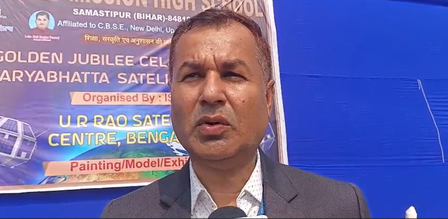
Samastipur (Bihar), Feb 9 (IANS) India is making rapid progress towards establishing its own space station while simultaneously advancing the Gaganyaan human spaceflight mission, ISRO Programme Director Imtiyaz Ahmed said on Monday.
Work is currently underway on nearly 80 satellites that will play a crucial role in scientific research innovation, disaster management, internal security, navigation, and relaying critical signals for the Gaganyaan mission back to Earth, the senior ISRO official said.
Speaking to IANS in Samastipur on the occasion of the golden jubilee of India’s first indigenously developed satellite, Aryabhata, Ahmed noted that such missions are central to strengthening India’s space-based capabilities and technological self-reliance.
He said ISRO is presently engaged in several major projects, including Earth Observation missions, Navigation with Indian Constellation (NVS), the Indian Data Relay Satellite System (IDRSS), Gaganyaan and the Venus Orbiter Mission. Together, these initiatives reflect India’s expanding footprint in space science, exploration and applied technologies.
Recalling the historic launch of Aryabhata on April 19, 1975, Ahmed said the satellite, named after the ancient Indian mathematician and astronomer, represented a landmark moment in India’s scientific journey. Despite limited technological resources and infrastructure during the Cold War era, the success of Aryabhata laid the foundation for future space missions and helped ISRO emerge as a globally respected space agency. Its legacy, he said, continues to inspire generations of scientists and engineers.
To mark the golden jubilee of Aryabhata, the ISRO has launched a nationwide outreach programme for school students. As part of this initiative, the first programme in Bihar was held on Monday at Holy Mission High School in Samastipur, with students from five different 10+2 schools participating.
During the programme, students were introduced to the ISRO’s work and future opportunities in the space sector. Scientists also shared their personal experiences, noting that many of them studied in Hindi-medium schools, encouraging students to dream big and aspire to careers in space science and technology.
–IANS
sn/vd