Radio Brisvaani

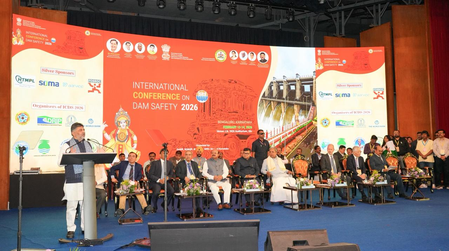
Bengaluru, Feb 13 (IANS) Karnataka Deputy Chief Minister D.K. Shivakumar, who also holds the Water Resources portfolio, expressed confidence that the state will implement the pending Mekedatu and Upper Krishna projects if the Central government grants the necessary approvals.
“We are hopeful that the Centre will extend its cooperation,” he said at the inaugural session of the International Dam Safety Conference held at the J.N. Tata Auditorium of the Indian Institute of Science here.
“You are all in Bengaluru, a city with a population of 1.5 crore. Industrialists from across the world are turning their attention to Bengaluru. The entire world views India through Bengaluru. Its climate and culture attract everyone. As more people wish to come here, the responsibility of supplying water to all rests on us. Therefore, we have moved forward with the construction of a balanced dam project in Mekedatu. Recently, the Supreme Court delivered a verdict in favour of this project. We are ready to implement it and are awaiting approval from the Central government. This project will provide drinking water to Bengaluru and surrounding regions and help generate 400 MW of electricity,” he said.
Noting that the Congress government has completed 1,000 days in office on Friday, Shivakumar said that in view of hosting this conference, they had postponed the celebration. “It is a matter of pride to host this unprecedented event. Karnataka is a state with a rich history. In 1902, Asia’s first hydroelectric power generation centre was established at Shivanasamudra. It was the first of its kind in Asia,” he said.
On the Upper Krishna Project, he said that the government has introduced a transparent policy and decided to provide better compensation to farmers who lose land, in accordance with the 2013 Act. “By December 2025, irrigation facilities will be provided to 1.72 lakh acres of agricultural land. We also request relaxation of the 500-metre restriction imposed around dams under dam safety guidelines. This will enable tourism activities near dams and support the local economy,” he said.
“Many of our dams are 60–70 years old, making infrastructure repairs essential. Additionally, unexpected climate changes have posed serious challenges,” Shivakumar stated.
“The strength of a dam lies not only in how it is built, but also in how well it is maintained. India has around 6,500 dams, ranking third among countries with the highest number of dams. Karnataka has 232 dams, and nearly two-thirds of the dams in the country are over 25 years old. This highlights the need to prioritise systematic dam safety,” he pointed out.
“Dam safety has now become a national priority. Through the Dam Rehabilitation and Improvement Project (DRIP), launched by the Central government with World Bank assistance, substantial support is being provided. In Karnataka, the second phase of DRIP is being implemented, with Rs 1,500 crore allocated for the repair of 58 dams,” he said.
“Water is wealth, water is energy, water is life. The Karnataka Government is committed to making the state a model in dam safety. We will build, protect and advance our dams,” he stated.
“We have gathered here today to discuss water management and dam safety. Karnataka has a rich tradition in water management. After Independence, thousands of dams were built under the visionary leadership of Pandit Jawaharlal Nehru, who described dams as the temples of modern India,” Shivakumar stated.
“Karnataka produces the highest number of engineers in the country. We have 250 engineering colleges and produce 1.5 lakh engineers every year. That is the strength of this state. Bengaluru is the Silicon Valley, with 25 lakh engineering professionals contributing significantly to the global technology sector. In comparison, California has only 13 lakh engineering professionals,” he said.
–IANS
mka/vd