Radio Brisvaani

New Delhi, Feb 23 (IANS) On February 17 in Kalyani, many felt Bengal were assured of entering the Ranji Trophy final after bagging a slender lead over Jammu & Kashmir. A big second innings score and that would have been enough for Bengal to get into the title clash against Karnataka.
But cricket is a great leveller and brings its own twists and turns beyond one’s imagination. The exact same thing happened when Bengal folded for 99, giving J&K a target of 126 which they chased down to get into the title clash starting in Hubbali on Tuesday.
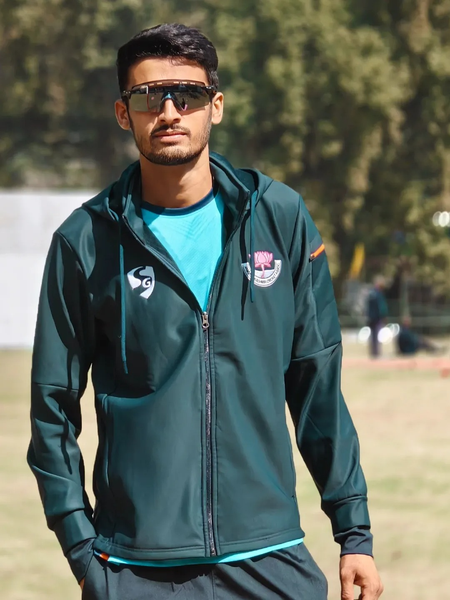
Apart from Auqib Nabi taking a sensational four-fer, his new ball partner Sunil Kumar also grabbed four scalps to put J&K in the driver’s seat for entering their first-ever Ranji Trophy final. Now, against Karnataka and a formidable batting line-up featuring KL Rahul, Devdutt Padikkal, Karun Nair and Mayank Agarwal, left-armer Sunil is ready for the biggest game of his life after having his coming-of-age moment in Kalyani.
“It has been very good to bowl with Nabi. There is no pressure when bowling alongside him because all the pressure is coming through him. The way he bowls, it feels like he is bound to get a wicket on every delivery. When that happens, then your job is to not give runs from the other side as they will get out to him and you just have to contain the runs from your side.
“When Vanshe (Vanshaj Sharma) hit that sixer, I was sitting at the back of the dugout. It was a very good and unforgettable moment for all of us. It was clear before that we were going to play the final, but then that feeling of entering the title clash was just unbelievable. We have now forgotten that victory since we reached Karnataka. The entire focus is on the final,” said Sunil in an exclusive conversation with IANS from Hubbali.
The bowling plan for Karnataka, Sunil feels, will be no different from the one that has worked all season and the one that dismantled Bengal inside two sessions in ways even the J&K camp hadn’t anticipated.
“The plan was simple – we wanted to get them out as soon as possible. But we didn’t think that they would get out in one or two sessions. We thought that even if they got out in three or four sessions, we would get a day to chase whatever total they would post.
“But as soon as we got the wickets quickly, we thought it could be easily chased down. The bowling plan was the same – we wanted to hit our basic line and length again and again so that they would make a mistake. But we didn’t think that they would suddenly get out in one or two sessions,” he recalled.
Sunil hails from Kathar, a scenic village nestled 35 kilometres from Akhnoor district in the Jammu region. The son of an Army man, Sunil played with a cosco ball as he fared better in cricket than his peers in the village, who believed he had the capabilities to make a career out of playing the sport.
“There are a lot of swing bowlers who I watched a lot. When I started watching cricket, I would take notice of India left-arm pacers Zaheer Khan and Irfan Pathan. I really liked Irfan Pathan’s bowling action and I used to try to copy it. So, by copying him, my action became like this. I also used to like the bowling of Dale Steyn and James Anderson,” said Sunil
When Pathan played for J&K as player-cum-mentor from 2018 to 2020, Sunil had a chance to meet him. “I went for a trial and that’s where I met him once. He asked me for my age and told me that I bowl very well and that I have a lot of time in hand,” he said.
An inter-college tournament first introduced him to leather-ball cricket. Trials followed, and then a talent hunt around 2021-22 brought him to the attention of J&K head coach Ajay Sharma. “Before I came to college, I used to play with a cosco ball. The first time I played leather-ball based cricket was through an inter-college tournament and that’s where my journey started. Gradually I came to know about trials and attended it. There I came to know that yes, I am fine and I can play cricket professionally.”
“Luckily I also did well in the talent hunt and we were called for a T20 camp and Ajay sir came there for the first time. I was first picked by the selectors from the talent hunt. When Ajay sir was there, I was playing in the C or D team. So, the next team match was A or B team and they said to put me in either of the two teams and make me bowl with the new ball. So, that’s how it started and where I am playing now, it’s because of that talent hunt. If it wasn’t for that, I wouldn’t have been able to achieve anything,” he said.
The commute from Kathar to J&K Sports Hostel and Science College ground, where the JKCA camps were held, was a daily test of commitment in itself. “I had to travel 65 to 70 kms via scooty and if the camp was set up for 10am, then I had to leave at 8:15am so that I could reach by 9:45 to 9:50am. If camp ran till 2pm, I would then leave at 2:30pm and reach home by 4 or 4:30pm,” he said.
His family, he says, never stood in the way. “I didn’t take cricket just because I wanted to pursue it. My family knew that I play cricket. In terms of playing a game, when you want to achieve something really good, then it’s not that you want to get some return from it. You play for the love of that thing.
“I started like that and I’m still playing with the same mindset. So, their support was that they never stopped me for anything. I was good in studies, used to pass exams well and get good marks. So, I told them that I’m studying and playing and they were okay with it.”
Bowling coach P. Krishnakumar, who has overseen J&K’s pace attack for three seasons, identified Kumar early as a project worth investing in. “It’s a very, very big thing for him. He comes from Akhnoor, which is a very small place. He didn’t have a pitch to bowl and what he has done was, he has made a pitch in his own home. In the off-season, he calls and asks me on improving his bowling.
“We discuss and I tell him to do this and that. When he started, he was more of an out-swing bowler. He never had a good in-swing and I have developed his in-swing. I have developed his bowling from down the stick. So whatever I could do, I have done with him. He is very calm, like Auqib and is ready to work hard.
“In the first year only of me coming here, in the lunch and tea sessions, we used to do specific skill sessions and he also has picked up very quickly and that is why he is performing because a bowler can only perform if teer hai uske tarkash mein (there are many arrows in his quiver). Then only he can compete with that. If a batsman has more arrows, he will win, but if you have more than him, so you will win and it’s very simple,” he said to IANS.
Sunil also acknowledged the role of Krishnakumar in his development as a bowler. “The coaching staff is very helpful. Krishna Kumar has done a lot of hard work in getting a lot of basic things right, that were previously bad for me.
“He has worked a lot on my mental side as well. He always says that the more you keep your basics right, and the simpler you keep your plans, the better it is. He has helped me in the off-season a lot to become a lot better with my bowling.”
In eight matches of this season, Sunil has claimed 29 wickets at an average of 15.1, including two four-wicket hauls and as many five-fors. His first fifer came in Jammu against Hyderabad a moment he describes as the highlight of his first full-fledged domestic season.
“Playing in this season feels really good. This is my first season of playing domestic cricket and the performances have been fine, so I feel good about it. It was a very special moment to get my first fifer at our home ground and then get the second five-wicket haul against Himachal Pradesh in Amtar,” he said.
At 28, Sunil speaks with the measured certainty of someone who has had to wait long enough to know what patience in sports really means. “If you really want to do well in this game, then you have to work on yourself with small improvements to be made every day.
“Even if you find it boring or basic and start to think ‘what will even happen through it’, you have to keep doing it. One day God will give you the result as he sees the hard work you put in every day,” he concluded.
–IANS
nr/