Radio Brisvaani

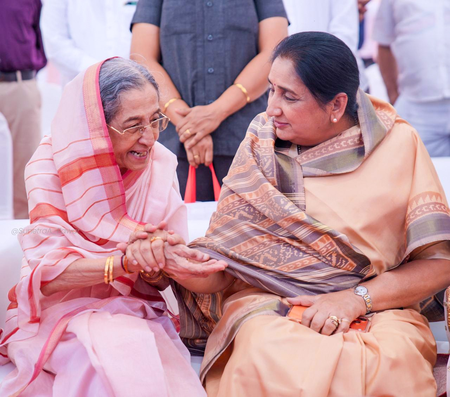
Mumbai, March 10 (IANS) In a major move to support working women, Maharashtra’s first woman Deputy Chief Minister, Sunetra Ajit Pawar, on Tuesday announced a new ‘Come Early-Go Early’ policy for female government employees in the Mumbai Metropolitan Region (MMR).
The announcement was made in the Legislative Council in her reply to a special discussion following International Women’s Day.
Under this new initiative, women employees can opt to arrive at work between 9:15 AM and 9:45 AM.
By starting early, they will be permitted to leave the office 30 minutes ahead of the standard closing time.
“This decision aims to provide significant relief to women by helping them avoid the heavy rush of peak-hour traffic and overcrowded local trains,” stated Sunetra Pawar.
The Deputy Chief Minister outlined a comprehensive roadmap for women’s empowerment, focusing on safety, economic independence, and health.
“Female government employees are now eligible for 180 days of maternity leave. Additionally, they can avail up to one year of half-pay leave without a medical certificate if required post-delivery. Through ‘Operation Muskan,’ the state has successfully traced 42,594 children between July 2015 and February 2026. Specialised ‘Missing Cells’ and 51 ‘Bharosa Cells’ are currently operational across all districts to address women’s grievances,” she said.
Pawar further said the government is aggressively implementing schemes like ‘Ladki Bahin’, ‘Namo Mahila Sakshami-karan’, and ‘Lakhpati Didi’. To support entrepreneurs, products from Self-Help Groups (SHGs) are being marketed via Umed Malls, Umed Marts, and online platforms.
“The ‘Adishakti Abhiyan’ has been launched to curb child marriage, reduce school dropout rates among girls, and create ‘abuse-free villages’ in rural Maharashtra. Dedicated systems have been installed at major railway hubs, CSMT, Churchgate, and Borivali, to prevent cyber crimes against women,” she added.
Responding to suggestions from various Council members, Pawar reaffirmed the government’s commitment to the Fourth Women’s Policy.
She emphasised that empowerment must be social, cultural, and mental, not just financial.
“We must strengthen our resolve to build a society that offers dignity, opportunity, and safety to every woman,” she urged, drawing inspiration from iconic figures like Mata Jijau, Savitribai Phule, and Ahilyabai Holkar.
On Monday, Maharashtra Minister of Women and Child Welfare Aditi Tatkare announced in the state assembly that the state would reinforce measures against online abuse and digital harassment, which she argued “kills the confidence of women trying to enter public or professional spaces.” This is necessary as she stated that cybercrime is the newest and most aggressive barrier to women’s progress.
In her reply to a special debate marking International Women’s Day, Minister Tatkare focused on moving beyond symbolic celebrations toward structural and digital empowerment.
She proposed grassroots training programs to help rural women navigate digital finance and social media safely, ensuring that technology remains a tool for growth rather than a source of fear.
–IANS
sj/dan