
Radio Brisvaani

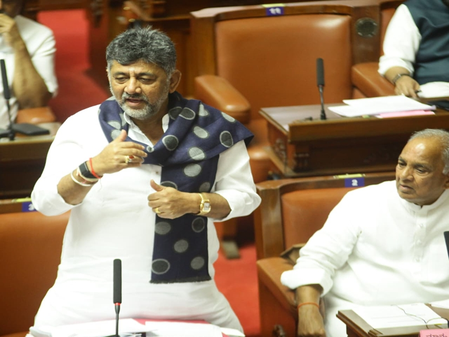
Bengaluru, March 12 (IANS) Karnataka Deputy Chief Minister D.K. Shivakumar on Thursday told the Legislative Council that all the crest gates of the Tungabhadra dam would be replaced by May this year.
Replying to JD(S) MLC T.A. Sharavana, who raised the issue of crest gate replacement at the Tungabhadra dam in the Legislative Council during Zero Hour, the Deputy Chief Minister, who also holds the Irrigation portfolio, said: “We are replacing all the gates of the Tungabhadra dam. It requires about seven days to replace one crest gate. As per media reports, 14 gates have been replaced till March 10. The replacement of gates will be completed as per schedule.”
“We had an agreement on June 10, 2025, with Ahmedabad-based Hardware Tool and Machinery Project Company to replace all the crest gates of the dam at a cost of Rs 34.48 crore within a period of 15 months. Fabrication work on 25 crest gates has been completed and two more gates are being fabricated. Fourteen gates have been replaced and the replacement of three more gates is underway. We have taken all measures to ensure completion of the work by May,” he explained.
“The Andhra Pradesh government is not coming forward for discussions on the Navali balancing reservoir. Some people have suggested alternative plans, but the Andhra Pradesh Chief Minister is not giving time for discussions. We cannot take a decision on this unilaterally; it needs to be decided by all three riparian states. Water is currently flowing into the sea, and we can harness it if you all support us politically,” he added.
When BJP MLC B.G. Patil raised a news report highlighting the non-release of compensation for landowners, the Deputy Chief Minister said: “I will seek the files on this from our officials and ensure immediate action.”
Responding in the Legislative Council during Question Hour after Congress member Aarthi Krishna raised concerns that many public toilets within the Greater Bengaluru Authority limits are not usable or citizen-friendly and suggested that artificial intelligence should be used to monitor their cleanliness, Shivakumar said that along with 388 existing public toilets, 441 new toilets are being constructed within the jurisdiction of the authority.
Shivakumar said: “There are 380 public toilets across the city. Out of these, 65 toilets have been handed over to retired civic workers to operate, while 20 toilets are being run by persons with disabilities. Under the Shubhra Bengaluru initiative, 60 toilets will be constructed. In addition, 191 toilets are currently under construction.”
He added that under the Swachh Bharat Mission, the Central government has provided Rs 13.5 crore, with which 90 toilets are being built. Another 100 toilets are being constructed under the Brand Bengaluru initiative, primarily for women.
“In total, there will be 441 new toilets along with 388 existing ones. If there is a need for toilets at specific locations, the public can bring it to our notice and we will examine the availability of land and construct toilets there as well,” he said.
During the discussion, BJP member Bharathi Shetty raised a question about the use of artificial intelligence in administrative reforms in the state.
Responding to the question, Shivakumar said that the world is entering a new era of artificial intelligence and discussions on the subject are taking place globally.
“We are entering a new age of artificial intelligence. The subject is being discussed worldwide and the Prime Minister also organised a major conference on this issue. Courts have also discussed the use of artificial intelligence, and the CBSE has been advised to include the topic in the curriculum from Classes 3 to 8,” he said.
However, he said that extensive research is required before introducing artificial intelligence in governance.
“Before deciding on the use of artificial intelligence in administration, there must be substantial research. It is difficult to take a decision without proper study. Even in the Legislative Council, unless documents are scanned and uploaded to computers, they cannot become digital,” he explained.
He added that artificial intelligence cannot create anything entirely new on its own. “It only produces results based on the information that is fed into it,” he said.
Sharing a personal anecdote, Shivakumar said: “When I once called my personal assistant to ask for information while preparing a speech, my daughter told me not to ask him and instead use ChatGPT. When I tried it, I received a lot of information. I have experimented with artificial intelligence in this manner, but its accuracy still needs improvement.”
He further said that unless documents are uploaded into computer systems, information cannot be retrieved digitally.
“For example, in courts, information becomes available only after previous judgments are uploaded. But judgments cannot be written solely based on those records,” he said.
–IANS
mka/pgh