Radio Brisvaani

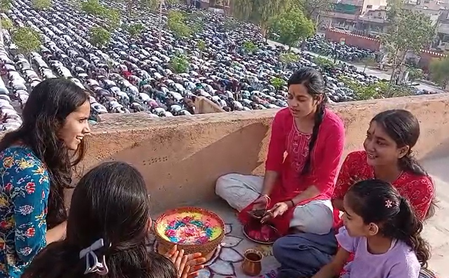
Bikaner (Rajasthan), March 21 (IANS) In another significant example of Ganga-Jamuni Tehzeeb, a harmonious blend of Hindu-Muslim traditions, Rajasthan’s Bikaner, on Saturday, showcased peaceful co-existence of two different religious communities. While Eid-ul-Fitr prayers was offered by Muslim worshippers on one side, Hindu girls performed ‘Gangaur’ rituals on the other.
Setting a precedent for communal harmony, young girls from the Hindu community sang traditional songs on a terrace as they went about their rituals for the ‘Gangaur’ festival, while men from the Muslim community offered ‘namaz’ nearby.
Celebrated in various parts of India, particularly Rajasthan, Haryana, Madhya Pradesh and Uttar Pradesh, this year the ‘Gangaur’ festival is being observed on Saturday, March 21.
The festival is dedicated to the worship of Lord Shiva and Goddess Parvati. ‘Gangaur’ is specifically observed by women. Unmarried girls observe ‘Gangaur’ to seek an ideal life partner, while married women pray for the long life, prosperity and well-being of their husbands.
Meanwhile, Eid-ul-Fitr, which signifies the conclusion of the holy month of Ramadan, is also being observed by Muslims across the globe including India, on Saturday.
Falling on the same date, the city witnessed a peaceful conduct of traditions and norms followed by both the Hindu and Muslim communities.
According to historian Ravi Bhatt, the nawabs of Awadh played a key role in shaping Ganga-Jamuni ‘tehzeeb’, the shared Hindu-Muslim cultural tradition that continues to define the city of Lucknow.
During an event held in Delhi last year, Bhatt said that with political authority shifting from Delhi, the nawabs focussed on building institutions that supported art, literature, and social practices across communities. He further mentioned that their courts encouraged interaction between different traditions, which gradually shaped a common cultural space.
Earlier, the Ganga-Jamuni Tehzeeb was also in focus during Dev Deepawali celebrations in Varanasi last year. Muslim women took part in preparing one lakh lamps from cow dung, which was lit on the ghats of Varanasi during Dev Deepawali.
–IANS
cg/rad