Radio Brisvaani

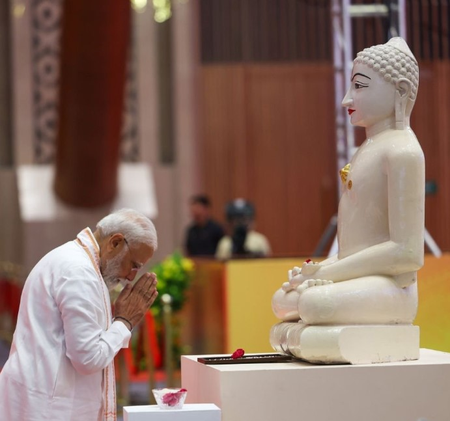
New Delhi, March 31 (IANS) Prime Minister Narendra Modi on Tuesday extended greetings to the countrymen on Mahavir Jayanti and wished that the teachings of Bhagwan Mahavir continue to illuminate the path of truth, non-violence and compassion.
Mahavira Janma Kalyanaka is one of the most significant religious festivals in Jainism. It commemorates the birth of Mahavira, who is the 24th and final Tirthankara of the current Avasarpini. This festival is celebrated in March or April according to the Gregorian calendar.
Taking to X, PM Modi said, “Best wishes on the sacred occasion of Bhagwan Mahavir Janma Kalyanak. The life and teachings of Bhagwan Mahavir continue to illuminate the path of truth, non-violence and compassion. His ideals are spiritually uplifting and also deeply relevant in today’s world. His emphasis on equality and kindness reminds us of our shared responsibility towards society.”
He also shared glimpses of the Samrat Samprati Museum at Koba Tirth in Gujarat’s Gandhinagar, which will be inaugurated later in the day.
“May the thoughts of Bhagwan Mahavir always give strength and hope to humanity”, the Prime Minister added.
PM Modi will visit Gujarat on Tuesday to inaugurate the Samrat Samprati Museum at Koba Tirth and launch several significant development projects across the state, covering cultural, technological, and infrastructural milestones.
Speaking ahead of his visit, the Prime Minister said in a post on social media: “The Samrat Samprati Museum is a testament to the rich legacy of Jainism and India’s civilisational traditions. It will provide visitors with a chronological understanding of the evolution of Jainism and its contributions to humanity.”
At around 10:00 a.m., on the occasion of Mahavir Jayanti, Prime Minister Modi will inaugurate the Museum on the campus of the Mahavir Jain Aradhana Kendra.
Named after Samrat Samprati, the grandson of Emperor Ashoka and a revered figure in Jain history, the museum features seven wings, each dedicated to a distinct aspect of India’s civilisational traditions.
Visitors can view over 2,000 rare artefacts, including intricately crafted stone and metal idols, large Tirth Patta and Yantra Patta, miniature paintings, silver chariots, coins, and ancient manuscripts.
The exhibits, complemented by modern audio-visual and digital installations, provide an immersive experience for scholars, researchers, and visitors.
–IANS
sd/