Radio Brisvaani

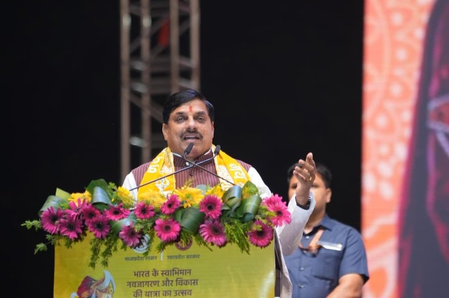
Ujjain, April 4 (IANS) Chief Minister Mohan Yadav on Saturday praised India’s remarkable progress in space research while attending a special session on the second day of the international conference “Mahakal: The Master of Time” at the Varahamihira Astronomical Observatory in Dongla, Ujjain district.
The session, themed “The Present and Future of Astronomy and Space Research in India”, saw scientists briefing the Chief Minister on the country’s major space milestones and ambitious upcoming missions.
Yadav described the presentations as “highly fascinating” and expressed delight over India’s achievements in the field.
He particularly commended the success of the Chandrayaan-3 mission, saying such feats inspire the youth to pursue careers in science, research, and innovation.
Prof. Anil Bhardwaj, Director of the Physical Research Laboratory (PRL), Ahmedabad, detailed the historic achievements of Chandrayaan-3.
He highlighted the successful soft landing of the Vikram Lander, which made India the fourth nation to achieve a soft landing on the Moon and the first to reach the Moon’s South Pole.
He noted the critical role played by Artificial Intelligence and Machine Learning in the mission’s success. The Pragyan Rover conducted important scientific studies on the lunar surface, and the landing site was named “Shiv Shakti Point.”
Prof. Bhardwaj also outlined India’s future roadmap, including Chandrayaan-4 (Lunar Sample Return Mission), Chandrayaan-5 (LUPEX, a joint India-Japan mission), the Venus Orbiter Mission, the Mars Lander Mission, and the goal of landing Indian astronauts on the Moon by 2040.
Tarun Pant, Director of the Space Physics Laboratory at Vikram Sarabhai Space Centre, Thiruvananthapuram, spoke about the importance of studying the ionosphere and upper atmosphere, explaining how space activities influence Earth’s climate and atmosphere.
Other sessions on the second day covered topics such as “Progress in Astronomy and Astrophysics,” “Space Economy: Space Technology in the Service of the Nation,” and the scientific dimensions of Indian Knowledge Tradition.
V.K. Saraswat, Member (Science) at NITI Aayog, emphasised that space technology has become a cornerstone for both national security and development.
He recalled how the news of a satellite launch in his childhood inspired him to enter the field.
He highlighted the rapid evolution of defence technology, including drones and AI-based systems, and praised the growing role of the private sector and startups in achieving the vision of “Atmanirbhar Bharat.”
Shankar Nakhe, former Director of the Raja Ramanna Centre for Advanced Technology (RRCAT), stressed that science and spirituality are complementary.
He noted that Ujjain’s ancient connection with timekeeping and astronomy, due to the Mahakaleshwar Temple and its location on the Tropic of Cancer, makes the conference especially significant.
He advocated for a balanced society through the harmonious integration of science and spirituality.
The conference featured rich discussions on the space economy, private-sector participation, and expanding opportunities for youth in the space sector.
Experts underlined that space technology is emerging as a powerful driver for scientific progress, economic growth, and job creation.
–IANS
sktr/dan