Radio Brisvaani

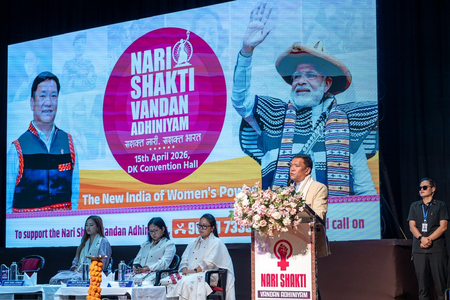
Itanagar, April 15 (IANS) Arunachal Pradesh Chief Minister Pema Khandu on Wednesday underscored that women’s participation in policymaking is a crucial indicator of development, pointing out that developed nations often have 40-50 per cent representation of women in governance.
Addressing a special programme themed “Celebrating Strength, Equality and Leadership,” organised to mark the spirit of women’s empowerment and raise awareness about the ‘Nari Shakti Vandan Adhiniyam’, the Chief Minister noted that India currently has about 13.6 per cent women representation in the Lok Sabha and approximately 9 per cent in state Assemblies.
In Arunachal Pradesh, he said, only four women legislators are part of the 60-member Assembly, highlighting the urgent need to enhance women’s participation in politics. Speaking before an audience comprising women leaders, achievers, students, and dignitaries, Khandu described the ‘Nari Shakti Vandan Adhiniyam’ as a historic reform poised to transform India’s political and governance landscape.
He highlighted that the legislation, passed in 2023 under the leadership of Prime Minister Narendra Modi, provides for 33 per cent reservation for women in Parliament and state Assemblies. The Chief Minister recalled that the demand for women’s reservation dates back to 1996, with several attempts made over the years before the Bill was finally passed in 2023 with broad political consensus.
Khandu informed that a special session of Parliament scheduled from April 16 to 18 will focus on finalising rules and implementation modalities, aiming to operationalise the reservation by the 2029 elections. Urging women to aim beyond the 33 per cent quota, he called for active participation in leadership roles and decision-making processes.
Highlighting various initiatives for women’s empowerment, the Chief Minister cited schemes such as the Dulari Kanya Scheme, which provides Rs 50,000 support for higher education of girl students and has benefited over 13,800 individuals so far. He also referred to the HPV Vaccination Campaign, offering free vaccines to 14-year-old girls, with 19,000 beneficiaries identified in its first phase.
Further, Khandu noted that the Pradhan Mantri Matru Vandana Yojana has supported over 37,000 beneficiaries, while the PM Poshan Scheme has reached around 35,000 individuals. Khandu also emphasised the success of the Self-Help Group (SHG) movement in the state, stating that since 2016, more than 1.5 lakh women have become actively involved. The government now plans to strengthen cooperative movements to further expand women-led enterprises.
Encouraging women to explore entrepreneurship, he highlighted opportunities under MSME initiatives, urging them to register and benefit from financial assistance, loans, and skill development programmes. He stressed that empowering women at the household level is fundamental to achieving broader socio-economic transformation.
The Chief Minister lauded several women achievers from Arunachal Pradesh across diverse fields, including noted author Mamang Dai, Indian Army officer Ponung Doming, entrepreneur Tage Rita Takhe, the state’s first woman IPS officer Tenzin Yanki, Padma Shri awardee and mountaineer Anshu Jamsenpa, traditional medicine practitioner and Padma Shri awardee Yanu Jamoh Lego, and academician Jamuna Bini.
He also praised women athletes for significantly contributing to Arunachal Pradesh’s improved performance in national-level sports competitions, noting that the state now ranks among the top performers. Calling for electoral reforms, Khandu urged political parties to nominate capable women candidates rather than relying on proxy representation.
He stressed the importance of enabling women to lead independently and effectively. Expressing optimism for the future, the Chief Minister said he hopes Arunachal Pradesh will one day have a woman Chief Minister, and encouraged women to actively engage in public life.
Describing the Nari Shakti Vandan Adhiniyam as a “game-changer,” Khandu urged women across the state to participate in discussions, break barriers, and take up leadership roles in governance and development.
He also acknowledged the contributions of the Prime Minister, Members of Parliament, and other stakeholders in passing the legislation, stating that it would significantly strengthen women’s empowerment and accelerate India’s journey towards Viksit Bharat 2047 and Viksit Arunachal 2047.
–IANS
sc/uk