
Radio Brisvaani

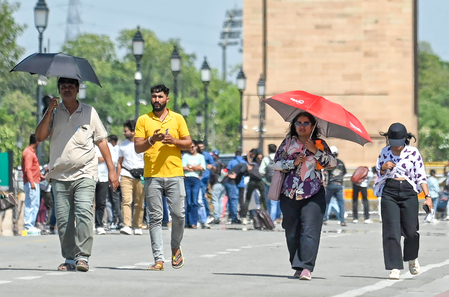
New Delhi, April 17 (IANS) Temperatures across the Delhi-NCR region are set to rise sharply over the next few days, according to the latest forecast issued by the IMD. The mercury is expected to cross the 40-degree Celsius mark soon, intensifying heatwave-like conditions across the region. At the same time, deteriorating air quality continues to pose serious health risks to residents.
Thursday turned out to be the hottest day of the season so far in Delhi-NCR.
At Safdarjung, the base weather station, the maximum temperature was recorded at 40.3 degrees Celsius — about 3.4 degrees above normal. Other areas also reported high temperatures, including Lodhi Road at 40.1 degrees Celsius, Palam at 39.4 degrees Celsius, and the Ridge area touching 41.4 degrees Celsius, significantly above normal levels.
On Friday, the maximum temperature in Delhi was recorded at 37 degrees Celsius, while the minimum stood at 21 degrees. The weather is expected to remain clear in the coming days. The maximum temperature is likely to rise to 38 degrees Celsius (minimum 22 degrees) on April 18, followed by 39 degrees (minimum 23 degrees) on April 19. Similar conditions are expected to persist on April 20, with the temperature hovering around 39 degrees and the minimum remaining at 23 degrees.
According to the Meteorological Department, the temperature is expected to touch the 40-degree mark by April 21 and 22. On both days, clear skies are forecast, with maximum temperatures reaching 40 degrees Celsius and minimum temperatures around 24 degrees. The rapid rise in temperature signals the onset of peak summer conditions in the region.
Cloud movement is expected to continue on April 18, but rainfall is unlikely. The India Meteorological Department has predicted mostly clear weather for the next seven days, with only occasional light clouds.
With no significant rain expected, Delhi-NCR residents have limited chances of respite from the heatwave conditions.
Alongside rising temperatures, air pollution levels have become a growing cause for concern. The Air Quality Index (AQI) in several parts of Delhi and adjoining areas remains above safe limits, increasing the risk of respiratory ailments, particularly among vulnerable groups.
In Delhi, an AQI of 310 was recorded in Bawana, 268 in Anand Vihar, 281 in Ashok Vihar, and 191 in Aya Nagar. Experts warn that an AQI exceeding 300 falls under the ‘very poor’ category and can have serious health implications with prolonged exposure.
In Greater Noida, the AQI at Knowledge Park-V was recorded at 368, placing it firmly in the ‘very poor’ category, while Knowledge Park-III reported an AQI of 275. In Noida, Sector-116 recorded an AQI of 312, also in the ‘very poor’ category. Other areas such as Sector-1 (269), Sector-125 (259), and Sector-62 (253) continue to report AQI levels ranging from ‘poor’ to ‘very poor’.
Ghaziabad remains the worst-affected area in the NCR, with Loni recording an AQI of 387 — the highest in the region. Nearby areas also reported alarming levels, including 362 in Ved Vihar-Loni, 334 in Indirapuram, 285 in Vasundhara, and 282 in Sanjay Nagar.
Authorities and health experts have advised residents to limit outdoor exposure, stay hydrated, and take necessary precautions as both heat and pollution levels continue to rise.
–IANS
jk/dpb