Radio Brisvaani

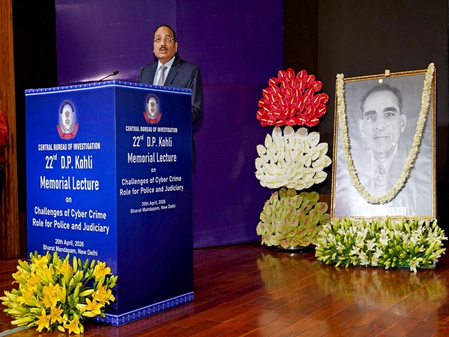
New Delhi, April 20 (IANS) Chief Justice of India (CJI) Surya Kant on Monday stressed the urgent need for a transition towards real-time enforcement mechanisms to effectively combat the rapidly evolving threat of cybercrime in the country.
Delivering the 22nd D.P. Kohli Memorial Lecture at Bharat Mandapam, the CJI said that traditional enforcement approaches are proving increasingly inadequate in the face of cyber offences that are “transnational, fast-paced and anonymous” in nature.
The lecture, organised by the Central Bureau of Investigation (CBI), focused on the theme “Challenges of Cyber Crime: Role for Police and Judiciary”, bringing together stakeholders from law enforcement and the legal fraternity.
Highlighting systemic gaps in the current framework, the CJI pointed to the mismatch between the real-time execution of cybercrimes and the often delayed and fragmented institutional response by authorities.
He called for real-time coordination among key stakeholders, including banks, telecom service providers, digital platforms, and investigative agencies, to enable swift detection, response, and mitigation of cyber threats.
Calling for a broader paradigm shift in approach, CJI Kant underscored the importance of adopting technology-driven solutions such as automated detection systems, early warning mechanisms, and integrated command structures.
He stressed the need to build capacity in digital forensics, cyber intelligence, and specialised training within investigative and enforcement agencies to deal with complex cyber threats.
“Effectively addressing cybercrime requires a coordinated, anticipatory and collaborative approach,” he said, adding that judicial adaptability and robust technological safeguards must complement enforcement efforts.
The CJI identified capacity building, inter-agency collaboration, and technology-led governance as key pillars in strengthening the institutional response to cybercrime in India.
On the occasion, the CJI also launched ‘ABHAY’, an AI-powered chatbot aimed at helping citizens verify the authenticity of notices purportedly issued by the CBI, particularly in light of the rising instances of so-called “digital arrest” scams involving impersonation.
The CBI organises the annual lecture series in honour of its founder Director, Dharamnath Prasad Kohli, whose leadership laid the institutional foundation of the agency in its early years.
Established by a Union government resolution dated April 1, 1963, the CBI was mandated to investigate cases of bribery and corruption, violations of central fiscal laws, and other serious crimes, and has since evolved over the decades into India’s premier investigative body.
Kohli, who led the Delhi Special Police Establishment (DSPE) before becoming the first Director of the CBI, is widely credited with strengthening investigative processes, institutional credibility, and organisational integrity.
–IANS
pds/pgh