Radio Brisvaani

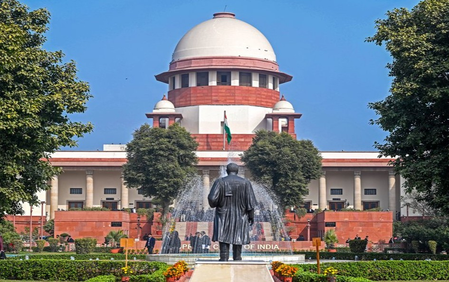
New Delhi, April 21 (IANS) As a nine-judge Constitution Bench continued hearing the Sabarimala review reference, the Supreme Court on Tuesday orally remarked that the Constitution may come to the aid of a devotee who is denied access to a deity solely on the basis of birth.
During the course of the hearing, Justice Ahsanuddin Amanullah posed a question to senior advocate V. Giri, appearing for the Sabarimala ‘thantri’ (chief priest), asking whether a permanent exclusion founded on birth identity would withstand constitutional scrutiny.
“Suppose I go to a temple with complete devotion, believing the deity to be my creator. Yet, I am told that because of my birth or lineage, I can never touch the deity. Will the Constitution not come to the rescue?” Justice Amanullah questioned.
The Bench, headed by Chief Justice of India (CJI) Surya Kant and comprising Justices B.V. Nagarathna, M.M. Sundresh, Ahsanuddin Amanullah, Aravind Kumar, Augustine George Masih, Prasanna B. Varale, R. Mahadevan, and Joymalya Bagchi, is examining a batch of petitions raising broader questions on discrimination at places of worship and the scope of religious freedom under Articles 25 and 26 of the Constitution.
Responding to the apex court’s query, Giri submitted that the right to worship under Article 25 must be in consonance with the essential characteristics of the deity.
He argued that no devotee can claim a right to worship in a manner that is “antagonistic” to the nature of the deity as understood within the religious tradition.
“When a devotee goes to a temple for worship, it cannot be in antagonism to the characteristics of the deity,” Giri contended, adding that believers must accept the essential attributes of the deity, including the concept of “Naishtika Brahmachari” (perennial celibate) associated with Lord Ayyappa at Sabarimala.
At the same time, Giri acknowledged that exclusion purely on the basis of birth from performing priestly functions would be impermissible. “If it is merely birth which constitutes a disqualification… that would be wrong and invalid,” he submitted, indicating that such issues could be addressed through legislation under Article 25(2)(b).
The 9-judge Bench also engaged with the question of whether believers themselves can challenge denominational practices.
Justice Prasanna B. Varale observed that, with changing times and education and exposure, believers may question age-old traditions.
“Can it be said that a believer must accept everything without rational inquiry?” he asked, indicating that traditions may evolve over time.
Justice Joymalya Bagchi similarly queried whether internal dissent within a denomination could be brought before a constitutional court.
“If a believer himself challenges a practice as not forming part of the core faith, what would be the role of the court?” he asked.
Responding, Giri maintained that questioning integral practices would fall outside the bounds of religious belief.
“If I go for worship, I cannot then question the very manner in which that worship is structured,” he submitted.
However, Justice M.M. Sundresh observed that adjudicating claims of an individual believer against the collective belief of a denomination may pose difficulties under Articles 25 and 26, particularly where the majority adheres to a common practice.
The hearing forms part of the larger reference arising from the 2018 Sabarimala judgment, in which a five-judge Bench held that the exclusion of women aged 10 to 50 from the Sabarimala Ayyappa Temple was unconstitutional.
Subsequently, in 2019, a Constitution Bench referred a batch of review petitions and related issues concerning religious practices across faiths to a larger Bench for authoritative determination.
–IANS
pds/dan