Radio Brisvaani

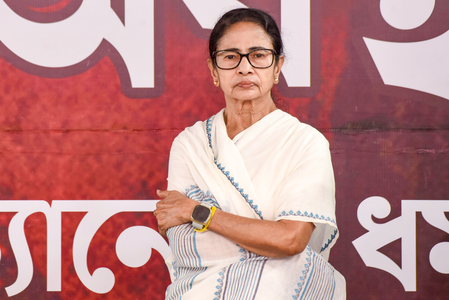
New Delhi, May 3 (IANS) In February 2019, Mamata Banerjee wrote an 18-line poem titled ‘Key’, lamenting what she saw as a ‘shrinking’ democratic space under the regime at the Centre. The poem spoke of voices being stifled, of lips metaphorically locked, and of a reckoning that would one day confront those in power. It was a political message wrapped in verse — sharp, accusatory, and unambiguous in its intent.
Seven years on, those very lines seem to echo differently — an uncomfortable reflection of realities.
When hundreds of residents, mostly women, in the Falta area of South 24 Parganas took to the streets on May 2, alleging threats and intimidation by Trinamool Congress workers, the essence of that poem stood exposed. Mamata Banerjee has repeatedly invoked the language of democracy and rights in her attacks on the Modi-led government at the Centre, but moments like these have a way of holding up a mirror.
For years, CM Banerjee has taken on the Bharatiya Janata Party-led government at the Centre, accusing it of undermining institutions and eroding democratic norms. That narrative has been central to her political positioning, but the 2026 Assembly election has, in many ways, peeled back layers that had long remained obscured.
Fifteen years of uninterrupted rule by the Trinamool Congress have created a deeply entrenched system — one where the lines between political authority and local muscle have blurred.
Allegations of voter suppression, coercion, and systemic intimidation are no longer confined to opposition rhetoric; they are increasingly finding expression in public protests and on-the-ground accounts. There have been even reports — denied by the ruling party — of voters in gated communities being discouraged or prevented from stepping out to vote.
The fact that the Election Commission of India found it necessary to set up polling booths within certain residential complexes points to an environment where access to voting itself became a concern.
Equally troubling were visuals that circulated widely: the symbol of a political party reportedly obscured on Electronic Voting Machines. BJP candidate Debangshu Panda accused the Trinamool Congress of deliberately obstructing voters from casting ballots in the BJP’s favour. Such claims raise serious questions about procedural integrity. Election guidelines are clear — every candidate’s symbol must remain visible. That these incidents could occur at all leads to an obvious question: Were they overlooked, ignored, or was there any threat?
The Falta protests also brought forward specific accusations. Some of the women named individuals they claimed had threatened or attacked them, pointing towards links with local political figures, including Jahangir Khan. Khan, in turn, made headlines for issuing open threats to a Central observer, Ajay Pal Sharma, even invoking the possibility of violence against security forces. Khan is widely believed to be close to Abhishek Banerjee, Mamata Banerjee’s nephew and a key figure within the party. Abhishek himself drew attention for remarks directed at the same Central observer, stating that he will see who comes to his rescue from Delhi after May 4.
What makes this moment significant is not just the incidents themselves, but the fact that they are no longer whispered about in private or dismissed as partisan exaggeration. They are out in the open, shaping public perception in real time.
West Bengal has, in recent years, witnessed a series of episodes that have raised questions about governance and institutional integrity. The murder of a young female doctor within the premises of RG Kar Medical College and Hospital had sparked widespread outrage. The protests that followed gradually lost momentum, with several participants alleging pressure and punitive actions, including transfers. Some of these actions were challenged before the Calcutta High Court.
Corruption allegations have also cast a long shadow. Several ministers and leaders, including Partha Chatterjee, Firhad Hakim, late Subrata Mukherjee, Madan Mitra, Sovan Chatterjee, Anubrata Mandal, have faced investigations and arrests in cases involving substantial financial irregularities. The recovery of large amounts of cash and valuables during the ED raid at Partha Chatterjee’s shocked many, not just for the scale involved, but for what it suggested about the depth of the problem.
In April 2025, the Supreme Court upheld the cancellation of over 25,000 teaching and non-teaching appointments linked to irregularities in a 2016 recruitment process. It was a decision with far-reaching consequences — affecting livelihoods on one hand, and exposing systemic corruption on the other. In most circumstances, such a verdict would trigger widespread political churn. The relatively muted response from large sections of the opposition, barring the BJP, stood out.
The truth is that the 2026 Assembly elections could prove to be a watershed moment in Bengal’s history. They have, in many ways, fully exposed the very system that Mamata Banerjee once fought against to come to power 15 years ago, but has since gone on to replicate and entrench. The methods she once opposed have now become the means through which she has sustained her hold on power.
Her remarkable feat of single-handedly dislodging the Left’s long rule now stands overshadowed by her presiding over a corrupt, exploitative system as revealed by the numerous cases in the courts.
Images of her obstructing an ED raid at the I-PAC office in Kolkata and removing files from the spot are likely to linger. So too will the incident in Malda, where a group of judicial officers was allegedly held hostage for nearly nine hours, and their convoy was later chased by a mob on over 30 bikes after their release. An audio message from one of the women officers to the High Court, describing her fear and distress during the ordeal and urging authorities to take care of her children if anything were to happen to her, underscores the gravity of the situation.
Today, the criticism she faces is rooted in a perception that the very methods she once opposed have, over time, found a place within her own administration.
The images of protesters on the streets, the accounts of voters struggling to exercise their franchise, and the recurring allegations of coercion — all of these form a narrative that is difficult to ignore. They may not tell the entire story of governance in West Bengal, but they certainly tell a part of it that demands attention.
In the end, the irony is hard to miss. A poem once written to warn against the erosion of democracy now reads like an unintended mirror. Whether that reflection leads to introspection — or is dismissed as political noise — will shape not just an election outcome, but the direction in which the state moves next.
For Mamata Banerjee, the questions are no longer just about political positioning. They are about credibility, consistency, and the gap between words and lived reality. And those are not questions that can be answered by poetry alone.
(Deepika Bhan can be contacted at deepika.b@ians.in)
–IANS
dpb/sd/