Radio Brisvaani

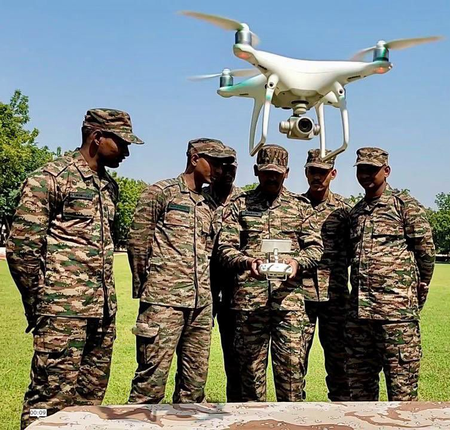
New Delhi, May 5 (IANS) India’s push towards next-generation warfare has gathered remarkable pace, with the Indian Army transforming its soldiers into ‘drone warriors’ within a year of Operation Sindoor, significantly boosting its combat capabilities and technological edge on the battlefield.
As the first anniversary of Operation Sindoor approaches, defence officials say drones have emerged as one of the most decisive and lethal tools in modern warfare, prompting a rapid and structured integration across all Army formations.
The initiative received a major push on Kargil Vijay Diwas last year when Army Chief General Upendra Dwivedi announced the creation of dedicated drone units known as Ashni Platoons. Officials confirm that these platoons have now been fully established and deployed across infantry battalions, marking the completion of the first phase of the Army’s ambitious drone induction programme.
According to officials, the initial phase focused on basic training at the unit level, ensuring that every soldier in infantry battalions acquires fundamental drone operation skills. This phase has been successfully completed, meaning all infantry soldiers now have basic proficiency in handling drones.
The second phase, currently underway, involves specialised advanced training at the formation level. Under this, the most skilled drone operators identified during the basic training phase are selected for intensive instruction.
The advanced training is conducted in two stages. In the first stage, soldiers undergo simulator-based training for 15 to 20 hours, where they learn the technical aspects of drone operations. This is followed by field training under real-world conditions, enabling them to handle operational challenges and obstacles effectively.
At formation-level training centres, batches of around 20 to 25 soldiers undergo rigorous training programmes lasting two to three weeks. Notably, the Army is also extending this training to personnel from other services, fostering joint operational capabilities.
Officials said the training covers a wide spectrum of drone applications, including surveillance drones, First Person View (FPV) drones, armed drones, and logistic drones. During Operation Sindoor, drones played a critical role not only in surveillance and combat support but also in neutralising enemy aerial threats, with Indian forces successfully shooting down Pakistani drones.
The Army’s drone ecosystem is also expanding rapidly, with dedicated training nodes being set up and scaled up across formations. Alongside this, procurement and deployment of advanced drone and counter-drone systems are being accelerated.
Each infantry battalion now has a dedicated Ashni Platoon, designed to function as a specialised drone unit within the formation. In parallel, institutional training infrastructure is being strengthened, with drone training centres established at the Indian Military Academy in Dehradun, the Infantry School in Mhow, officially known as Dr Ambedkar Nagar, and the Officers Training Academy in Chennai.
Importantly, not just soldiers but officers are also being trained extensively in drone operations, reflecting a comprehensive shift in operational doctrine.
The Army has conceptualised its drone warfare approach under the doctrine titled ‘Eagle in the Arm’, aimed at making drones as integral to soldiers as their primary weapons. Under this concept, soldiers are trained to deploy drones across multiple roles — combat, surveillance, logistics, and even medical evacuation.
In addition to operating drones, troops are also being trained in counter-drone techniques, enabling the Army to build a layered defence system capable of both deploying and neutralising aerial threats.
Defence officials emphasised that the long-term objective is to ensure complete integration of drone capabilities across the force. The aim is that by 2027, 100 per cent of infantry personnel will be proficient in drone operations.
–IANS
sn/uk