Radio Brisvaani

New Delhi, May 7 (IANS) Post the Pahalgam terror attack, Prime Minister Narendra Modi was under immense pressure to act against Pakistan. Islamabad would have hoped that the retaliation would be very limited and India would not go that extra mile, considering that it is a nuclear state.
As many experts note, Operation Sindoor not just rewrote India’s security doctrine, but also called out Pakistan’s nuclear bluff. The operation was devised in such a way that it went on to punish Pakistan-backed terror without going into an all-out war.
Going into the operation, the Government of India was well aware of the international pressure that would follow. Most nations would cite the nuclear issue and would urge India to show restraint. However, an attack like Pahalgam had to be avenged. The one line that the PM had while responding to the International community was that a bullet would be answered with a bomb.
Officials say that for long, Pakistan had taken advantage of the fact that India would treat an act of terror as a cross-border terror attack. The national security planners advising the Prime Minister made it clear that Pakistan had taken advantage of this stance for a long time, and it was time to change the doctrine. Operation Sindoor proved that a terror attack on Indian soil would be treated as an act of war.
The April 22, Pahalgam attack was probably one of the most audacious. On the face of it, the attack seemed to have been carried out only to disrupt the tourism industry in Jammu and Kashmir. However, the attack had a larger meaning and was aimed at disturbing communal harmony across India. The terrorists, belonging to the Lashkar-e-Taiba, segregated victims by religion and killed 26 innocent people.
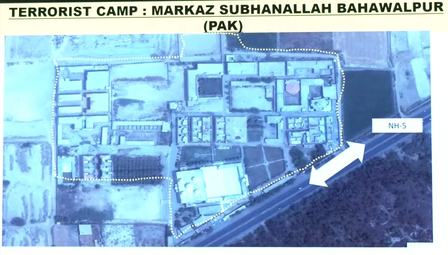
The Indian armed forces were given a free hand by PM Modi. On May 7, a BrahMos cruise missile struck the Jaish-e-Mohammad’s headquarters in Bahawalpur. The missile was fired from a Su-300 MKI, while the paired French SCALP air-launched cruise missile came off a Rafale.
The next target that was hit was the Lashkar-e-Taiba’s main training facility at Muridke. This camp has been used to train terrorists for multiple attacks in India, including the dreaded Mumbai 26/11 attacks. To hit Muridke, the armed forces used the SCALP and Israeli Crystal Maze missiles.
Other terror camps were hit by the loitering munitions Harop, Harpy, Polish Warmatae and Israeli PALM 200/400. An official said that while the armed forces continued to take down terror infrastructure in Pakistan and Pakistan-occupied Kashmir (PoK), Islamabad indulged in peddling fake news. With pressure growing from the people of Pakistan, the army’s stooges took to social media to spread false news about the Indian armed forces. They claimed that they had won, but the reality was different.
The real blow came on May 10 at 1:30 a.m. India launched scores of BrahMos missiles at the Chakala/Noor Khan air base in Rawalpindi. This led to the crippling of the command and control network. This hit was strategic as it crippled Pakistan’s Northern Air Command.
India continued to hit with more BrahMos missiles, which landed at Jacobabad and Bhanot. The operation was so intense that the Pakistan army pushed back 10 kilometres in Pakistan-occupied Kashmir (PoK) in several forward areas. At the end of it, not just the terror infrastructure had been destroyed, but 11 Pakistan air bases had been crippled.
Pakistan also lost seven planes owing to Operation Sindoor. With so much damage, the Pakistani army realised that this operation had to stop. The DGMO of Pakistan reached out to his Indian counterpart, following which a ceasefire was announced.
Although Pakistan continued to violate the ceasefire, India chose not to respond as it thought it should honour what was agreed upon. The Prime Minister and his team had sent out a strong message that India would respond to a bullet with a bomb.
–IANS
vn/sd/