Radio Brisvaani

New Delhi, May 13 (IANS) It was relatively a low-key oath-taking ceremony for the new regime in Puducherry on Wednesday compared with the recent high-profile events in West Bengal, Tamil Nadu, and Assam, even as the Congress continues to struggle to name the Kerala Chief Minister.
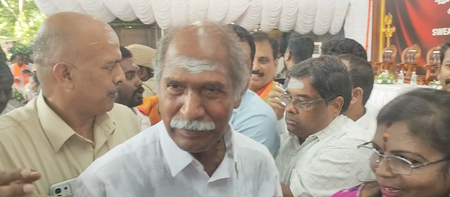
Significantly, All India NR Congress (AINRC) founder N Rangasamy took the oath of office and secrecy as the Chief Minister of Puducherry for a record fifth time. Assembly elections to the four states and the Union Territory of Puducherry were held last month, and the results were announced on May 4.
Puducherry witnessed a simple transition — led by a familiar regional figure — reflecting the territory’s compact political landscape, the personal standing of its leader, and strategic coalition choices that favoured stability.
Rangasamy led the National Democratic Alliance (NDA) to an 18-seat victory in the Puducherry Assembly’s total strength of 30. The AINRC won 12, while allies Bharatiya Janata Party (BJP) got four, and the All India Anna Dravida Munnetra Kazhagam and Latchiya Jananayaga Katchi (LJK) cornered one each.
Lieutenant Governor K. Kailashnathan administered the oath at Lok Niwas in the presence of central leaders like Bharatiya Janata Party president Nitin Nabin and Union Minister Mansukh Mandaviya.
Puducherry’s modern political shape grew from its French colonial past and the small, regionally concentrated electorate. It was formally integrated into India in 1962. Though its politics is sometimes linked to Chennai, the Union Territory has been preserving a distinct administrative and cultural identity.
An example has been the 2026 Assembly results. It has alternated between national parties and strong regional formations, with politics often shaped by local personalities, party splits, and alliances – rather than purely ideological battles. With Puducherry being a Union Territory, interactions between local governments and the central administration — especially when different parties control each — have been frequent, influencing both policy outcomes and political narratives.
The continuance of a “double engine government” may result in more understanding and coordination, providing better results for the region. Local development, administrative efficiency and welfare delivery have often mattered more to Puducherry’s electorate than the identity politics or national ideological battles that dominate larger states, producing elections that favour pragmatic, locally rooted leaders.
The political journey of 75-year-old Rangaswamy, a lawyer-turned-politician, has been marked by a strong grassroots presence and an image centred on governance and administration. He entered politics through the Congress and first assumed office as the Chief Minister of Puducherry in 2001, with his initial tenure helping cement his position as one of the Union Territory’s most influential political leaders.
Following his differences with the Congress, Rangaswamy founded the AINRC in 2011 and led it to a victory, serving as Chief Minister from 2011 to 2016. Since then, he has returned to power subsequently, including a more recent term – 2021-2026 – following a hiatus when he served as the Leader of Opposition in the Assembly.
His tenure is commonly described as pragmatic, centred on local development, and marked by coalition-savvy politics that privilege administrative delivery over grandstanding. Rangaswamy’s return as Chief Minister removed uncertainty and the need for elaborate celebrations.
When a widely known leader re-assumes office, ceremonies are often more administrative than confrontational, say observers. Rangaswamy’s track record appears to have made his leadership expected rather than surprising.
–IANS
jb/snj/skp