Radio Brisvaani

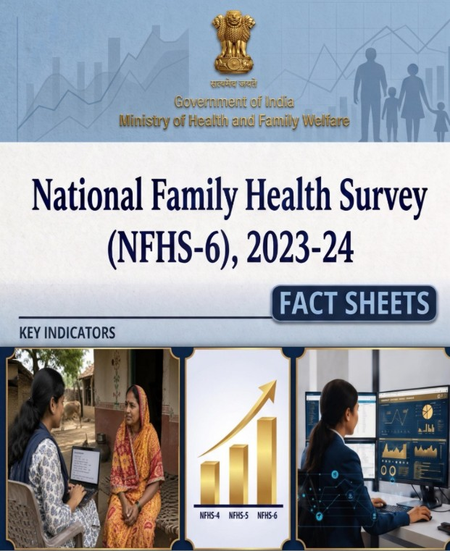
New Delhi, May 29 (IANS) The Ministry of Health and Family Welfare (MoHFW) on Friday released the National Family Health Survey (NFHS)-6 that reflected progress in health, nutrition, and social development indicators linked to sustained policy interventions flagship programmes, an official said.
The NFHS-6 was conducted during 2023-24 by MoHFW with the International Institute for Population Sciences (IIPS), Mumbai, as the nodal agency.
Covering nearly 6.79 lakh households across 715 districts, the survey provides vital evidence on population, health, nutrition and family welfare indicators and supports evidence-based planning and programme implementation up to the district level.
“Key findings from NFHS-5 (2019-21) to NFHS-6 (2023-24) showed significant improvement in the areas of safe motherhood, institutional deliveries, improved maternal and child healthcare,” a statement said.
The NFHS-6 highlights significant improvements in maternal and child healthcare services across the country.
As many as 95.9 per cent of pregnant women received antenatal care (ANC), while mothers receiving ANC in the first trimester increased from 70 to 76.2 per cent.
“Mothers receiving at least four ANC visits also increased from 58.5 to 65.2 per cent, reflecting stronger continuity of maternal healthcare services,” the statement added.
Institutional deliveries increased from 88.6 to 90.6 per cent, moving India closer towards universal coverage.
“Births attended by skilled health personnel improved from 89.4 to 91.3 per cent, while postnatal care for newborns by doctor/nurse/Lady Health Visitor (LHV)/Auxiliary Nurse Midwife (ANM)/Midwife/other health personnel within two days of delivery improved from 79.1 to 85.3 per cent,” the statement said.
“Maternal nutrition indicators also showed notable improvement. Mothers consuming iron folic acid supplements for 100 days or more during pregnancy increased from 44.1 to 54.9 per cent, while those consuming supplements for 180 days or more rose from 26 to 37.8 per cent,” the statement added.
“These gains reflect strengthened public health infrastructure and improved access to maternal and child healthcare services across the country, driven by focused implementation of initiatives such as Janani Suraksha Yojana (JSY), Janani Shishu Suraksha Karyakram (JSSK), Pradhan Mantri Surakshit Matritva Abhiyan (PMSMA/e-PMSMA), Surakshit Matritva Aashwasan (SUMAN), Facility Based New-born Care, Home-Based Newborn Care, and Pradhan Mantri Matru Vandana Yojana (PMMVY 2.0),” the statement said.
“These programmes have enhanced antenatal and postnatal care coverage, ensured quality care during pregnancy and childbirth, and promoted safe motherhood and child health practices,” it added.
The NFHS-6 also indicated encouraging progress in child nutrition outcomes.
As many as 95.6 per cent of children aged under six months were found to be breastfed during the survey period.
“The percentage of children aged under three years breastfed within one hour of birth increased by nearly 10 percentage points from 41.8 per cent to 50.1 per cent,” the statement said.
“Stunting (low height for age) among children under five years declined substantially from 35.5 to 29.3 per cent, reflecting improvement in long-term nutritional outcomes,” it added.
The marked reduction in stunting prevalence provides strong evidence of improvement in long-term nutritional transition and child health outcomes in India.
The NFHS-6 recorded that the use of hygienic methods of menstrual protection among women aged between 15-24 years has increased from 77.6 to 79.2 per cent, supported by initiatives such as the Menstrual Hygiene Scheme (MHS) within the Rashtriya Kishor Swasthya Karyakram (RKSK) and the affordable sanitary products under the Pradhan Mantri Bhartiya Janaushadhi Pariyojana.
“These initiatives have enhanced awareness, accessibility, and adoption of safe menstrual hygiene practices in the nation,” the statement said.
–IANS
rch/khz