Radio Brisvaani

New Delhi: The exposition of the sacred relics of the Buddha is far more than a religious ceremony or a cultural event. It is a civilisational act that reconnects humanity with one of the greatest spiritual traditions born on Indian soil. For millions of Buddhists across the world, relics are not archaeological objects preserved in museums. They are living embodiments of Lord Buddha’s presence, teachings and compassion. Their exposition inspires devotion, reflection and a renewed commitment to the values of peace, wisdom and ethical living.
In recent years, India has revived global awareness of Buddha Dhamma through renewed engagement with Buddhist nations, development of pilgrimage circuits, international Buddhist conferences and the exposition of sacred relics abroad. Prime Minister Narendra Modi’s statement that “India has given Buddha to the world, not war” has come to symbolise India’s civilisational approach to international engagement rooted in dialogue, peace and coexistence.
At a time when the world faces conflict, social fragmentation and rising extremism, the message carried by the Buddha’s relics has acquired even greater relevance.
Myanmar occupies a special place in India’s Buddhist outreach.
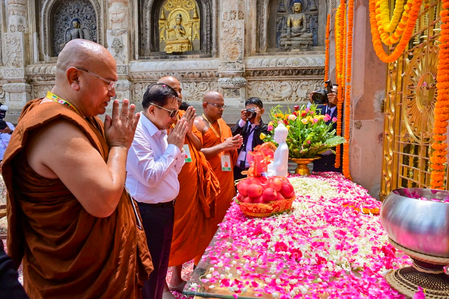
The recent visit of Myanmar’s President to India U Min Aung Hlaing to India demonstrated the depth of this spiritual relationship. Significantly, he began his visit not with political engagements but with prayers and meditation under the sacred Bodhi Tree at the Mahabodhi Temple. He also visited the Burmese Monastery, underlining the enduring spiritual bonds that connect Myanmar with the land where the Buddha attained enlightenment.
His participation in the major relic exhibition inaugurated in New Delhi was equally important. Together, Bodh Gaya, the monastery visit and the exposition of the Piprahwa relics provided a practical model for India’s future engagement with Buddhist countries. They demonstrated how faith, culture, diplomacy and people to people relations can reinforce one another.
For Myanmar, relics associated with the Buddha occupy a place of extraordinary reverence. Portions of relics from the Piprahwa discovery were historically distributed to Buddhist countries including Burma, now Myanmar, where they became objects of national devotion and spiritual identity. Even today, Myanmar remains one of the strongest custodians of the Theravada Buddhist tradition that originated in India.
Among all archaeological discoveries linked to Buddhism, few possess greater significance than the relics discovered at Piprahwa Stupa.
Excavations first carried out by William Claxton Peppé in 1898 revealed reliquary caskets containing bone fragments, ashes, crystals, pearls and ornaments associated with the Buddha. Later excavations by K. M. Srivastava further strengthened the evidence that Piprahwa preserved one of the earliest relic deposits connected with the historical Buddha.
For Buddhist communities, these relics provide a direct connection with the Buddha and the earliest history of Buddhism.
More importantly, they remind the world that while Buddhism became a shared heritage of Asia, its origins remain firmly rooted in India. The Buddha walked on Indian soil. His teachings emerged from Indian civilisation. The earliest relics were enshrined in India. The great centres of Buddhist learning flourished in India.
India’s greatest strength does not lie merely in possessing relics or sacred sites.
Its true strength lies in being the birthplace of Buddha Dhamma itself.
It was from India that monks, scholars and travellers carried Buddhist philosophy across mountains, deserts and oceans. Centres such as Nalanda Mahavihara, Vikramashila University and Takshashila shaped intellectual traditions across Asia. Indian scholars transmitted not only religion but also philosophy, ethics, language, art, architecture and systems of knowledge.
This remains India’s most enduring source of influence.
Relics inspire devotion. Teachings create transformation.
Therefore, every relic exposition should be accompanied by Dhamma discourses, scholarly exchanges, publications, university collaborations and cultural programmes that explain the philosophical foundations of Buddhism to contemporary audiences.
The strategic relevance of Buddhist heritage should not be underestimated.
Across Asia, Buddhist identity continues to influence public consciousness and cultural memory. In this environment, authenticity matters. The Piprahwa relics carry a moral and spiritual authority that cannot be replicated because of their direct association with the Buddha and their connection to the land of his birth and teachings.
For countries such as Myanmar, Sri Lanka, Thailand, Cambodia, Laos, Mongolia, Japan and Vietnam, engagement with India through Buddhist heritage creates a unique foundation of trust and goodwill that extends beyond conventional diplomacy.
India should move beyond viewing relic expositions as occasional events.
A sustained Buddhist engagement strategy is needed.
Indian ambassadors in Buddhist countries should actively promote awareness of India’s sacred Buddhist heritage, pilgrimage circuits, universities and philosophical traditions. Missions abroad should regularly organise Dhamma talks, academic seminars, monastic exchanges, youth interactions, cultural festivals and heritage exhibitions throughout the year.
This effort should not depend solely on government run Buddhist organisations.
Universities, monasteries, scholars, think tanks, cultural institutions, private foundations and civil society groups must become active participants. A broader ecosystem will ensure continuity and innovation while expanding India’s reach among Buddhist communities worldwide.
Myanmar provides an excellent template. The President’s pilgrimage to Bodh Gaya, his visit to the Burmese Monastery and his participation in the relic exposition together demonstrated how spiritual diplomacy can strengthen bilateral relations while respecting religious sentiment.
The Piprahwa relics are more than a sacred inheritance. They are a reminder of India’s enduring civilisational responsibility as the birthplace and principal custodian of Buddha Dhamma.
For Myanmar, they represent a profound spiritual bridge connecting generations of devotees with the land of the Buddha.
For India, they offer an opportunity to strengthen cultural and strategic partnerships across the Buddhist world.
The challenge now is to maintain the momentum. Buddhist diplomacy must become a regular and institutionalised feature of India’s international outreach. If pursued with sensitivity, scholarship and reverence, it can deepen long term relationships, strengthen India’s civilisational standing and carry forward a message of peace and compassion that remains as relevant today as it was 25 centuries ago.
(The author is a former diplomat and strategic affairs expert. Views expressed are personal)
–IANS
/as