Radio Brisvaani

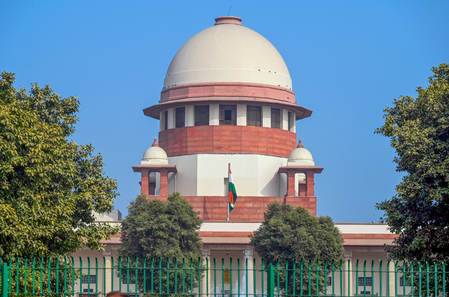
New Delhi, June 24 (IANS) The Supreme Court on Wednesday dismissed a plea challenging the Economic Weaker Sections (EWS) criteria in the context of admissions to private medical colleges, refusing to accept the contention that the annual income ceiling of Rs 8 lakh for EWS candidates becomes meaningless when private medical colleges charge tuition fees running into lakhs of rupees.
A Bench of Justices B.V. Nagarathna and Joymalya Bagchi declined to interfere with a Rajasthan High Court judgment that had rejected the challenge mounted by Rajasthan domicile candidate Harshvardhan Singh, who had argued that the fee structure of private medical colleges effectively rendered EWS reservation illusory for economically weaker students.
During the hearing, the Justice Nagarathna-led Bench orally observed that self-financing private institutions could not be compelled to charge fees at par with government medical colleges merely because seats are reserved for EWS candidates.
The apex court highlighted the distinction between government and private educational institutions, remarking that government colleges receive financial support from the public exchequer while private colleges operate on a self-financing model. “These are self-financing institutes. For government ones, they get grants from the State. There is a vital difference,” the Justice Nagarathna-led Bench said.
It further said that while capitation fees are prohibited, that does not mean private colleges cannot charge regular tuition fees fixed under the applicable regulatory framework.
When the petitioner argued that EWS candidates from families earning less than Rs 8 lakh annually could not realistically afford annual tuition fees ranging between Rs 18 lakh and Rs 25 lakh in private medical colleges, the top court suggested that financial assistance mechanisms were available. “If you are unable to pay, get a scholarship,” the Justice Nagarathna-led Bench said.
The special leave petition (SLP) arose from a Rajasthan High Court judgment delivered in May this year.
The petitioner, an EWS candidate who appeared in NEET-UG 2025, had contended that private medical colleges in Rajasthan were charging tuition fees between Rs 18.90 lakh and Rs 25 lakh per annum despite the EWS income ceiling being fixed at Rs 8 lakh annually.
He had argued that charging EWS candidates the same fees as general category candidates defeated the purpose of the 10 per cent reservation introduced through the Constitution (103rd Amendment) Act, 2019, and sought directions for affordable fee structures for EWS students.
Rejecting the plea in May this year, a Division Bench of Justices Arun Monga and Sandeep Shah of the Rajasthan High Court had held that EWS reservation operates only at the stage of admission and does not, in the absence of any statutory provision, create a right to concessional fees in private medical colleges.
The High Court had observed that the fee structure of private medical colleges in Rajasthan had been fixed by the State Fee Regulatory Committee in accordance with the principles laid down by the Supreme Court in the Islamic Academy of Education v. State of Karnataka judgment, and that the underlying fee fixation order itself had never been challenged by the petitioner.
It further ruled that no statutory provision or binding policy in Rajasthan entitled EWS students to fee relaxation and that a National Medical Commission office memorandum relied upon by the petitioner was merely recommendatory and had not been adopted by the state government.
The Rajasthan High Court also found that all available EWS seats in the concerned college had already been exhausted during earlier rounds of counselling and that subsequent allotments were made in accordance with the applicable counselling regulations.
–IANS
pds/uk