Radio Brisvaani

New Delhi, June 28 (IANS) The revelation that donations offered by devotees at the Ram Temple in Ayodhya were allegedly stolen by some of the very people entrusted with counting and safeguarding them came as a shock to many Indians. The immediate response was not anger, but disbelief. The first question that came to mind was — how could they do it?
That question has lingered ever since. People steal from homes, shops, banks and businesses. Such crimes, unfortunate as they are, have become part of everyday headlines. But stealing money which devotees have offered at the temple is different because it crosses a line that many never imagined could be crossed.
Over the past two months, the country has witnessed two developments that have shaken public confidence — the donation theft at the Ram Temple and the NEET paper leak.
At first glance, the two cases have nothing in common. One concerns a temple. The other concerns a national entrance examination. But both reveal the same disturbing truth — those who were expected to protect the system allegedly chose to exploit it.
That is what makes these incidents far more serious than ordinary crimes.
Society can deal with criminals. It has laws, courts and prisons for that. What is much harder to deal with is the collapse of trust. Every institution, whether it is a temple, a school, a court or an examination body, functions because people believe those running it will do the right thing. The day the custodians themselves begin violating that trust, the damage goes far beyond.
For crores of Hindus, the Ram Temple is not merely another place of worship. It represents a centuries-old civilisational aspiration. The temple is the culmination of a long legal, social and emotional journey that generations witnessed and participated in. Every day, thousands of devotees travel to Ayodhya from every corner of the country. Some leave a few rupees in the donation box, others contribute larger amounts, some offer jewellery and some clothes. The value of the offering has never mattered, but what matters is the faith with which it is made.
Very few devotees pause to think about what happens after they drop the money into the donation box. They assume, quite naturally, that those entrusted with counting and safeguarding these offerings will discharge their responsibility honestly. That faith is as important as the offering itself. It is precisely this faith that has been shaken.
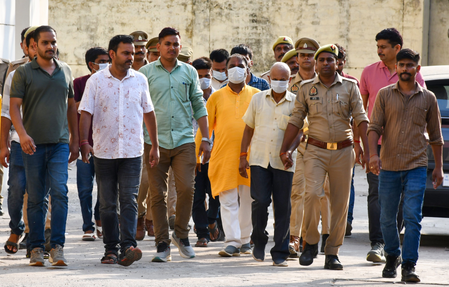
Eight people associated with counting the donations have been arrested after CCTV footage showed them removing wads of currency notes during the counting process. They were entrusted with safeguarding devotees’ offerings. Instead, they now stand accused of stealing them.
The Special Investigation Team submitted its preliminary findings, and an FIR followed. The investigation is still underway, and only the courts will ultimately determine individual guilt. The arrests and the CCTV footage have come as a painful shock to countless devotees.
The Shri Ram Janmabhoomi Teerth Kshetra Trust receives donations worth hundreds of crores every year. The temple also witnesses an average daily footfall of around 70,000 to 80,000 devotees, with numbers swelling at weekends and festivals. Handling offerings of this scale demands more than administrative efficiency. It demands integrity beyond question. People are not merely depositing money; they are placing their faith in the hands of those responsible for protecting it.
The same sense of betrayal is visible in the NEET paper leak case.
Lakhs of students spend years preparing for one examination. Families invest their savings, make sacrifices and build their hopes around the belief that merit will decide the outcome. But their trust was betrayed. Several teachers and subject experts appointed by the National Testing Agency (NTA) leaked final question papers and ran exclusive coaching sessions.
The allegations that teachers, paper setters and others associated with the examination process misused their positions have hurt not only individual students but also public confidence in the system itself.
A temple and an examination hall are very different places. One is built on faith, the other on merit. However, both ultimately depend on trust.
When a teacher leaks a question paper, it is not merely an academic offence. When a person entrusted with counting temple donations pockets the offerings, it is not merely theft. In both situations, the offender occupies a position that society expects to be above temptation. That expectation is what makes the alleged wrongdoing so disturbing.
Perhaps this is why these incidents have generated an emotion across the country. They touch something deeper than financial loss. They force people to ask uncomfortable questions about honesty, responsibility and values. What makes someone betray a responsibility placed in their hands with complete confidence? At what point does greed become greater than conscience? These are questions no investigation can answer.
The criminal justice system will do its job. Those found guilty will face the law. But legal proceedings alone cannot restore what has been damaged.
Despite everything, the stream of devotees heading to Ayodhya has not stopped. Every day, thousands continue to stand patiently in long queues for the darshan of Ram Lalla. They continue to bow their heads, fold their hands and make their offerings. Their faith in Lord Ram remains untouched.
Temples are ultimately sustained not by cash in donation boxes but by the devotion of those who walk through their doors. That devotion has survived wars, invasions and political disputes over centuries. It will survive this, too.
The law will take its course. The guilty will be punished. But for devotees, one question may never find an answer: How could they do it?
(Deepika Bhan can be contacted at deepika.b@ians.in)
–IANS
dpb/sd/