Radio Brisvaani

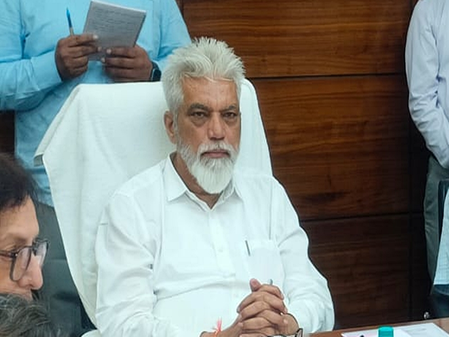
Mumbai, June 29 (IANS) Maharashtra Minister of School Education Dadaji Bhuse on Monday announced that, starting next year, a dedicated high-level committee headed by the Chief Secretary will be appointed to oversee the deployment of secure digital infrastructure to transition the Teacher Eligibility Test (TET) and all other state public competitive examinations entirely to a secure online format.
He made this announcement while delivering his statement in the Maharashtra Legislative Assembly on the high-profile paper leak in the Maharashtra State TET-2026 examination.
In order to mitigate the distress caused to the student community and restore institutional integrity, Minister Bhuse announced a transparent re-examination and an absolute fee waiver, in addition to a complete transition to online formats.
“A fresh, rescheduled TET-2026 examination will be organised in a strictly disciplined, highly secure and completely transparent manner. To ensure candidates face no financial penalties for system failures, no examination or re-registration fees of any kind will be charged to candidates appearing for the rescheduled test,” he said.
Minister Bhuse detailed immediate arrests, the registration of criminal cases under stringent new laws and comprehensive remedial structural reforms to protect the academic future of over six lakh affected candidates.
A formal case (C.R. No. 281/2026) has been officially registered at the Kongaon Police Station under the Thane City Police Commissionerate.
Acting on credible intelligence received on June 27, 2026, indicating that an organised syndicate was planning to sell the leaked question papers for the TET examination scheduled for June 28, the Thane City Police swiftly laid a strategic trap.
The operation led to the apprehension of three individuals. Upon conducting a search, authorities recovered authentic copies of the question papers intended for the upcoming examination.
Senior officials from the Education Department were rushed to the spot to verify the seized material. They subsequently confirmed that the documents were identical to the authentic question papers prepared for the scheduled examination, prompting an immediate postponement of the test across 1,728 centres, the Minister said.
The primary accused, identified as Rajiv Shriprayag Shaw, along with two accomplices, was caught in possession of the leaked papers.
Investigations reveal that the group acquired the documents through illicit channels and intended to sell them to desperate candidates in exchange for sums as high as Rs 1.5 crore.
The accused were formally arrested on June 27, 2026, and remain in police custody.
Law enforcement authorities have booked them under a formidable combination of the newly enacted Central penal code and state anti-malpractice laws.
Recognising the immense gravity and interstate scale of the operation, the Director General of Police (DGP), Maharashtra, issued an order establishing a high-level Special Investigation Team (SIT).
Headed by the Joint Commissioner of Police (Crime), Thane City, the SIT has fully taken over the probe, Minister Bhuse said.
To dismantle the wider network and capture the mastermind, multiple specialised raid teams have already been dispatched across state lines.
Furthermore, Minister Bhuse announced in the Assembly that legal options are being explored to amend or apply the Maharashtra Control of Organised Crime Act (MCOCA) to ensure that anyone found guilty of masterminding competitive examination leaks can be prosecuted under organised crime laws.
Earlier, Deputy Chief Minister Eknath Shinde last Saturday said that the state government is planning to invoke the stringent Maharashtra Control of Organised Crime Act (MCOCA) against the masterminds and key accused involved in the scam.
He stated that he would soon hold a detailed discussion with Chief Minister Devendra Fadnavis to implement this decision.
Emphasising that the state government operates on a strict policy of “zero tolerance” towards corruption, DCM Shinde noted that a paper leak is no longer just a financial malpractice but has taken the form of serious, structured organised crime.
–IANS
sj/pgh