Radio Brisvaani

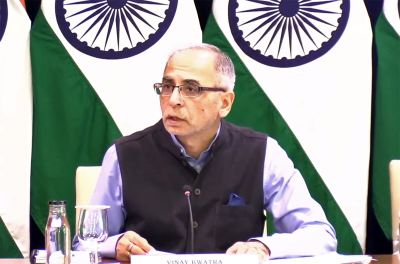
Washington, Aug 2 (IANS) India’s Ambassador to the US, Vinay Kwatra, has said that the Indus Water Treaty (IWT) was signed in a spirit of goodwill and friendship in 1960, but Pakistan spent 50 years dismantling this, and its abeyance “merely acknowledges what Pakistan’s conduct had already destroyed”.
The IWT was signed between India and Pakistan in 1960, concerning the utilisation of the waters of the Indus system rivers. Under the treaty, India received control over the three eastern rivers, which account for roughly 20 per cent of the basin’s water, while Pakistan received the water of three western rivers, which carry roughly 80 per cent of the water share.
“That asymmetry stifled development for decades in Indian regions that could have benefited from better water rights. India honoured the treaty anyway,” Kwatra, a former Foreign Secretary, wrote in an opinion piece in Newsweek.
However, after last year’s heinous Pahalgam terror attack, India exercised its rights as a sovereign nation under international law and placed the IWT in abeyance until Pakistan credibly and irrevocably abjured its support for cross-border terrorism.
The Indian envoy said that Pakistan’s approach towards India had been marked by wars, hostility and cross-border terrorist attacks, including on the Indian Parliament, the Mumbai terror attack, the Uri and Pathankot attacks and the Pahalgam attack. More than 40,000 people have been killed in India due to Pakistan’s terror campaign, according to Kwatra.
According to Kwatra, Pakistan’s approach to India-initiated projects was using obstruction and bureaucratic delays. Repeated targeting of Indian project sites, including the terrorist attack on the Tulbul Navigation Project in 2012, stopped India from exercising its rights under the treaty. Kwatra stated that Pakistan opposed India’s initiatives to renegotiate the treaty in view of the technological change, which would have enabled India to build its hydropower potential.
Pakistan “eroded India’s faith” that it could exercise its rights under the treaty or hope for a better one considering the current realities of the world, he said, noting that Pakistan was facing water scarcity due to its government’s “mismanagement.”
In the opinion piece, he said: “It is worth remembering that the treaty’s preamble declares it was concluded ‘in a spirit of goodwill and friendship.’ Pakistan spent half a century dismantling that goodwill and friendship. The abeyance merely acknowledges what Pakistan’s conduct had already destroyed.”
Responding to calls for India and Pakistan to resume talks, Kwatra said, “Prime Minister Narendra Modi has clearly voiced India’s stand today, ‘Terror and talks cannot go together… Terror and trade cannot go together…. Water and blood cannot flow together.’ Pakistan’s aggressive rhetorical incitement, casting India as a ‘water aggressor,’ betrays the truth that the water scarcity Pakistanis face today is the product of their own government’s mismanagement.”
Kwatra urged the Pakistan government to fix its dismal water productivity instead of holding conferences for blaming India and issuing threats.
“The habit of pinning every domestic failure on its neighbour has grown old. The world should say so, unequivocally. And, if Pakistan does sincerely want India’s cooperation on bilateral issues, it must first dismantle the terror infrastructure that it has built.”
–IANS
akl/vd