Radio Brisvaani

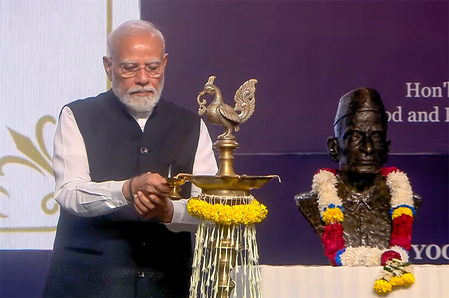
New Delhi, Sep 5 (IANS) Prime Minister Narendra Modi’s address at Shri Ram College of Commerce (SRCC) on Saturday was as much an outreach to India’s Gen-Z as it was a presentation of the government’s economic report card. Returning to the campus after 13 years, PM Modi sought to connect with a generation that has grown up in a digital, aspirational and rapidly changing India, placing youth at the centre of his vision for a developed nation.
His most direct message was one of confidence: “You will build a developed India.” PM Modi repeatedly positioned young Indians not merely as beneficiaries of development but as its principal architects. His reference to India becoming a global hub for research and innovation, and establishing its own space station was aimed at giving students a long-term, ambitious national horizon.
The choice of SRCC, one of Delhi University’s most prominent institutions, reinforced that pitch. Celebrating the college’s centenary, PM Modi highlighted its alumni and their influence across economics, business, law, art, leadership and the judiciary. Calling them the “OGs” in Gen-Z language was a deliberate attempt to bridge the distance between political messaging and the vocabulary of young audiences.
More significantly, PM Modi linked his youth appeal to a narrative of opportunity. His references to smartphones being manufactured in India, rising defence production, expanding exports and the growth of fintech were intended to demonstrate that the India young people are entering is structurally different from the India of a decade ago.
The Prime Minister’s emphasis on Made in India also had a generational dimension. Manufacturing, technology, entrepreneurship and innovation were presented as areas where young Indians can participate in building national strength rather than merely seeking opportunities abroad. Yet the address was not exclusively aspirational. PM Modi mixed his youth-focused message with pointed political attacks. His reference to the “Fragile Five”, Opposition criticism of economic data and his description of “Dimagi Naxals” showed that the outreach also carried a distinctly political edge.
His “Dimagi Naxal” remarks, in particular, shifted the tone from economic aspiration to ideological confrontation. By saying that those who reacted to the term were being watched by the country, PM Modi positioned himself as a leader willing to confront what he sees as forces opposing his broader national agenda.
The larger strategy was clear: Speak to Gen-Z about the future while using the achievements of the past decade as evidence that the future is already being built. At SRCC, PM Modi presented development, technology, national self-reliance and global ambition as interconnected elements of a new Indian identity—one in which the country’s youth are expected not simply to witness transformation, but to drive it.
–IANS
brt/uk