Radio Brisvaani

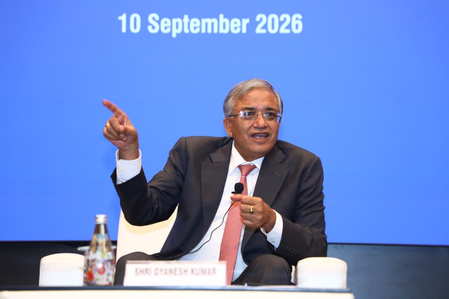
Ahmedabad, Sep 10 (IANS) India’s electoral process is conducted with strict adherence to the Constitution, election laws and instructions of the Election Commission of India (ECI), Chief Election Commissioner Gyanesh Kumar said on Thursday, describing the system as a vast and transparent mechanism that sustains the world’s largest democracy.
He was speaking at a special interaction with enlightened citizens on ‘Conducting Elections in India – The Largest Democracy in the World’ organised at the Ahmedabad Management Association (AMA).
Explaining the scale of the electoral exercise, CEC Kumar said India has around 90 crore voters and that conducting Lok Sabha elections is the world’s largest electoral process.
“Around 1.8 crore personnel are engaged in election duties during a general election, and managing such a large electorate and workforce reflects the distinctive capacity of India’s election system,” he emphasised.
CEC Kumar said the three principal stages of the electoral process are preparation of electoral rolls, polling and counting.
“Around 12 lakh Booth Level Officers (BLOs) verify electoral rolls by visiting voters’ homes. Continuous verification is carried out to ensure that eligible voters are included while ineligible names are removed,” he added.
He stressed that the basic objective of the electoral system is to ensure that every eligible person becomes a voter and that no ineligible person is included in the electoral roll.
The Chief Election Commissioner also highlighted the participation of political parties and candidates at different stages of the process.
“Booth Level Agents participate in the verification of electoral rolls, while mock polls are conducted on Electronic Voting Machines (EVMs) before actual polling begins,” he said.
He added that EVMs are not connected to the internet, Wi-Fi or Bluetooth.
“A mock poll is conducted in the presence of representatives of candidates before voting starts, and actual polling begins only after the functioning of the machines has been verified,” he said.
The CEC also added, “After polling, the total number of votes cast is recorded in Form 17C and the EVMs are sealed according to the prescribed procedure. During counting, the EVM results are also verified in the presence of counting agents of candidates.”
CEC Kumar said that technology is increasingly being used to improve communication within the election machinery.
“Integrated digital platforms such as ECI Net are being used for faster and more effective communication across the extensive election network. Communication that was earlier carried out through multiple applications has been integrated into a more effective digital system,” he added.
He also urged young people and other citizens to participate actively in the democratic process.
Every eligible citizen aged 18 years or above should register as a voter and exercise their right to vote, he said, adding that greater citizen participation strengthens democracy.
CEC Kumar said that elections to the President and Vice-President, Lok Sabha, Rajya Sabha and State Legislative Assemblies are conducted within the constitutional framework and prescribed legal procedures.
“Managing elections across a vast geographical area involving crores of voters is a distinctive feature of India’s democratic system,” he added.
During his two-day Gujarat visit, CEC Kumar also visited the historic Adalaj Stepwell after visiting Gandhi Ashram.
He observed the architecture and intricate carvings of the world-famous stepwell.
Gandhinagar Collector Ravindra Khatale and Adalaj Sarpanch Pragnyesh Patel welcomed CEC Kumar and presented him with a memento.
CEC Kumar also interacted with BLOs from Kumar and Kanya Primary School at Dantali, and primary schools in Jamiyatpura, Shertha and Manekba.
Central government tour guide Girish Gupta provided Gyanesh Kumar with information about the history and architecture of the Adalaj Stepwell.
Gujarat Chief Electoral Officer Sandeep Sagale and Archaeology Department Assistant Superintendent Dineshkumar Meena were also present during the visit.
–IANS
mys/khz