Radio Brisvaani

Dhar, Sep 15 (IANS) A fresh controversy has erupted in Madhya Pradesh’s Dhar after the district administration revoked permission for the ‘Varah March’ proposed by the ‘Sanatan Prahari Samiti’, citing security concerns and the need to maintain law and order.
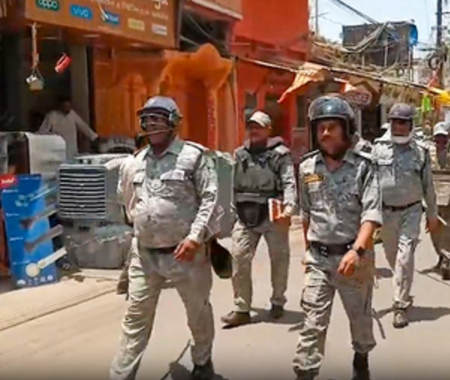
A heavy police force has been deployed across the city, and several office-bearers associated with the march were arrested on Tuesday morning. To prevent potential tension, the administration ordered the immediate removal of all posters and hoardings related to the event.
Anticipating unrest, the Archaeological Survey of India (ASI) kept the protected site at Ganjikhana closed to the public on Tuesday.
The historical structure is known as ‘Vijay Mandir’ by the Hindu community and ‘Lat Masjid’ by the Muslim community.
Assistant Superintendent of Police Vijay Dawar said that the permission was cancelled due to security concerns. He appealed to residents to maintain peace and avoid unnecessary movement outside their homes.
A large police contingent, including two dozen Station House Officers (SHOs), and officers of Sub-Divisional Officer of Police (SDOP) and Deputy Superintendent of Police (DSP) ranks, has been deployed. Fixed police pickets have been set up at the PG College ground and major intersections, while mobile vans are conducting continuous patrols.
Forces have been positioned in sensitive areas, and outsiders have been advised not to visit Dhar for the time being. Security will be further tightened during the period when the march was proposed.
The ASI issued a formal order closing the protected archaeological structure at Ganjikhana for the day, warning that any unauthorised entry or activity would invite action under the Ancient Monuments and Archaeological Sites and Remains Act, 1958. Surveillance is being carried out through CCTV cameras, drones and observation from high-rise buildings.
Police detained and subsequently “arrested” several office-bearers linked to the Varah March. Officials emphasised that the measures were taken solely to safeguard peace and prevent any untoward incident.
Historically, the mosque was constructed in 1405 CE by Dilawar Khan as the Friday mosque to mark his declaration of independence from Delhi and the founding of the Malwa Sultanate. Situated at the edge of the city, similar to arrangements in towns such as Chanderi, it derives its name from the fragmentary iron pillar also known as ‘Lat’ in Hindi, located within its compound.
The current controversy intensified after the Bhojshala site was handed over to Hindu organisations.
These groups now maintain that the Lat Masjid structure is not a mosque but the ‘Vijay Mandir (Temple of Victory)’, dating to the Paramara period (early 9th century). According to them, the temple was commissioned by King Bhoja following his conquest of the Telangana region. They claim that a specific pillar featuring an image of Lord Varaha, along with an ‘Ashtadhatu’ (eight-metal alloy) rust-resistant pillar presumably installed by King Bhoja himself and bearing a Varaha image, constitutes evidence of its original identity as a temple.
–IANS
sktr/dpb