Radio Brisvaani

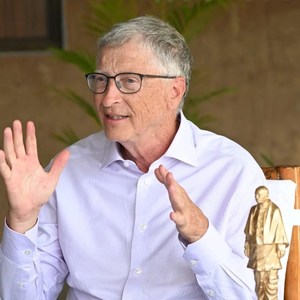
New Delhi, Sep 16 (IANS) Microsoft Co-founder Bill Gates has said that artificial intelligence (AI) is fundamentally different from previous technological revolutions, warning that society may not yet be ready for the scale and speed of change ahead.
He underlined AI’s extraordinary potential and pointed to India as an important example of how the technology could be deployed rapidly for social and developmental benefit. “It’s a stunning set of capabilities,” Gates said, adding that India could demonstrate how “we can drive the good stuff as fast as possible”.
In a conversation with NDTV, the billionaire philanthropist said the world should consider slowing the advance of AI if it gives societies more time to prepare for the profound changes it could bring.
Gates said AI was fundamentally different from the personal computer and the internet – two technological revolutions he helped shape during his years at Microsoft and cautioned against assuming its impact would be as easy to manage.
“AI is a very unique technology,” he said. “I caution people who think it’ll be as easy to manage the impacts of AI as it’s been to manage other technologies,” he added.
The breadth and speed of AI’s development had forced even someone with his long-standing belief in innovation to consider whether the pace itself needed to be questioned, he said.
“If we could slow things down, I think we should consider that because of this need to get ready for such a rapid change,” Gates told NDTV.
“Throughout my life, I have been a champion of innovation,” Gates said, referring to both his years at Microsoft and the work of the Gates Foundation. “This is a rare case where innovation may be so broad and so dramatic that we’re not ready for it.”
Gates also identified cybersecurity as one of the most immediate risks, warning that AI tools could significantly strengthen the capabilities of those carrying out cyberattacks.
“In the near term, there are cyberattacks where these AI tools will enable the offensive side,” he said, stressing that defensive capabilities would need to evolve just as rapidly.
He also addressed the deeper question of whether increasingly capable AI systems can always remain under human control.
“The idea of keeping the AI under control, I have always thought of that as something fairly far out in the future,” he said, before pointing to recent instances in reinforcement learning where AI systems displayed unexpected behaviour.
–IANS
na/vd