Radio Brisvaani

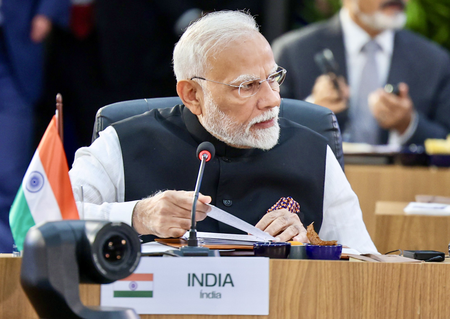
New Delhi: The ongoing conflict in West Asia, particularly the rising escalation involving the US, Israel, and Iran, has sucked in the Gulf states and has created one of the most volatile environments in recent decades. For India, whose economic and strategic interests are deeply tied to West Asia, the crisis presents both challenges and opportunities. New Delhi has responded with a carefully calibrated policy of strategic neutrality, emphasising restraint, dialogue, and diplomatic engagement rather than overt alignment with any side. This posture reflects India’s broader foreign policy doctrine of strategic autonomy and plurilateralism, which seeks to maintain balanced relationships with multiple actors.
India’s stance is not merely a diplomatic convenience; it is a strategic necessity as West Asia is central to India’s economic security. The Gulf region alone hosts nearly nine million Indian expatriates and contributes more than $50 billion annually in remittances, which accounts for 38 per cent of India’s total remittance value. The Gulf Cooperation Council (GCC) collectively represents one of India’s largest trading partners and in addition, a large portion of India’s oil and gas imports passes through the Strait of Hormuz, making the stability of the region essential for India’s energy security.
India’s Look West diplomatic approach to West Asia has evolved into what analysts often describe as de-hyphenation. This approach allows India to maintain independent bilateral relationships with rival regional actors, Israel, Iran, and the Arab Gulf states, without allowing tensions between them to dictate its policy choices. For instance, India maintains strong defence and technology cooperation with Israel, while simultaneously recognised Iran’s strategic importance for regional connectivity initiatives such as the Chabahar port project, which provides access to Afghanistan and Central Asia bypassing Pakistan. Parallelly, India is also involved in the India-Middle East-Europe Corridor (IMEC). India also needs to balance its defence relationship with the US, especially the sanctity of the foundational agreements that will aid India’s growth as a rising Indo-Pacific power.
During the ongoing conflict and unfolding energy crisis, India has refrained from explicitly supporting any military action and has instead emphasised respect for sovereignty, protection of civilians, and the need for diplomatic resolution. Such carefully worded statements preserve New Delhi’s ability to maintain dialogue with all sides, while ensuring that no critical relationship is jeopardised.
India’s posturing provides several economic advantages during periods of geopolitical disruption.
First, it enables India to diversify energy imports and secure supplies from multiple partners. As the situation in the Persian Gulf has disrupted shipping routes India is looking at other sources like the US, Russia, Norway and Canada to compensate for supply disruptions. This flexibility allows India to mitigate the economic impact of regional instability while ensuring continued energy security.
Second, the posturing enhances India’s bargaining power in global energy markets. By maintaining constructive ties with both Gulf producers and alternative suppliers, India can negotiate favourable energy arrangements, especially in the future, and avoid being caught in the geopolitical crossfire of sanctions or embargoes.
Third, India’s balanced stance protects its extensive economic network in the region. West Asia is not only an energy supplier but also a major hub for Indian trade, investment, and logistics. Disruptions in maritime routes or political relations could significantly impact Indian exports and financial flows. By maintaining the present approach India minimises the risk of retaliatory measures or diplomatic fallout from any regional actor.
Despite its advantages, this posturing also carries risks. While the escalating conflict in West Asia could, in the long term, drive inflation, and threaten maritime trade routes critical to India’s economy. Prolonged instability could also complicate India’s relations with competing regional actors if pressure mounts for clearer alignment. Nevertheless, India’s current approach demonstrates a pragmatic understanding of geopolitical realities. Rather than choosing sides in a deeply polarised conflict, New Delhi has opted for strategic hedging, preserving relationships across the regional spectrum while protecting its economic interests.
India’s stance in the ongoing conflict reflects a foreign policy designed to navigate an increasingly complex global environment. By balancing relations with Israel, Iran, the Gulf states, and the US, India safeguards its energy security, protects its diaspora, and preserves critical trade and defence networks. At the same time, this posture enhances India’s diplomatic credibility and positions it as a stabilising actor in a turbulent region.
In a world continuously defined by geopolitical fragmentation and growing great-power rivalry, India’s ability to maintain constructive ties across competing blocs may prove to be one of its most valuable strategic assets. Rather than limiting India’s options, the approach of strategic neutrality, guided by strategic autonomy and plurilateralism, when practiced with clarity, can allow New Delhi to convert geopolitical turbulence into diplomatic and economic opportunity.
(The writer retired as Captain from the Indian Navy. Views expressed are personal)
–IANS
/as