Radio Brisvaani

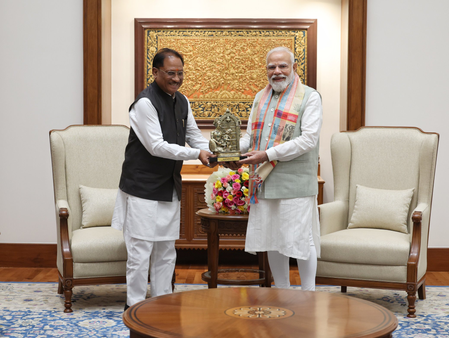
Raipur, April 9 (IANS) Chhattisgarh Chief Minister Vishnu Deo Sai has highlighted the significant progress in eradicating Naxalism from the state during his recent three-day visit to Delhi, where he held meetings with Prime Minister Narendra Modi and BJP National President Nitin Nabin.
Speaking to mediapersons, Chief Minister Sai credited Prime Minister Modi’s guidance, the strong resolve of Union Home Minister Amit Shah, and the bravery of security forces for successfully rooting out Naxalism from the region.
On behalf of the people of Chhattisgarh, he expressed heartfelt gratitude to the Prime Minister for this achievement. Chief Minister Sai particularly focused on the Bastar region, which remained deprived of development for nearly four decades due to left-wing extremism.
He apprised the Prime Minister about the government’s plans to accelerate progress in Bastar through the Bastar 2.0 development initiative. “During my time in Delhi, I met Prime Minister Narendra Modi and discussed the Bastar 2.0 development initiative. With his guidance, we aim to promote development in Bastar, enhance agriculture, increase the value of forest produce, and boost animal husbandry, fish farming, tourism, and homestay projects. I am grateful to the Prime Minister and to the people of Chhattisgarh, especially the residents of Bastar, who have waited decades for development,” the Chief Minister said.
The Bastar 2.0 plan aims to bring infrastructure, employment, and basic amenities to the tribal-dominated region now that peace has been restored.
The Chief Minister’s Delhi visit is seen as a step towards securing central support for transforming Bastar into a model of inclusive development.
Bastar, which was once severely affected by left-wing extremism, has witnessed a remarkable improvement in the security situation in recent years. With the near elimination of Naxal influence, the state government is now shifting focus from security operations to large-scale socio-economic development.
The Bastar 2.0 plan represents the next phase of this transformation, aiming to turn the region into a hub of infrastructure, innovation, startups, tourism, and sustainable livelihoods for its predominantly tribal population.
The initiative lays special emphasis on modernising agriculture through better irrigation and advanced farming techniques. It also seeks to add significant value to minor forest produce such as tendu leaves and mahua by improving processing, packaging, and market linkages, thereby increasing income for local tribal families.
Animal husbandry and fish farming will be expanded to create additional sustainable livelihood opportunities in remote areas, the chief minister said.
Tourism and homestay projects form a key pillar of the plan, with efforts to promote Bastar’s natural beauty, cultural heritage, traditional arts, and festivals. This is expected to generate employment for local youth while bringing economic benefits to villages.
The development blueprint is guided by a core strategy of saturating basic services, improving connectivity, facilitating growth, empowering communities, and engaging local people in the development process.
During the meeting, the Chief Minister also discussed major infrastructure projects, including the expansion of Jagdalpur airport, progress on the Raoghat-Jagdalpur railway line, and the establishment of a super-specialty hospital and medical college in the region.
He has extended a formal invitation to Prime Minister Modi to visit Bastar after the monsoon season to lay the foundation stones for several key initiatives.
–IANS
sktr/skp