Radio Brisvaani

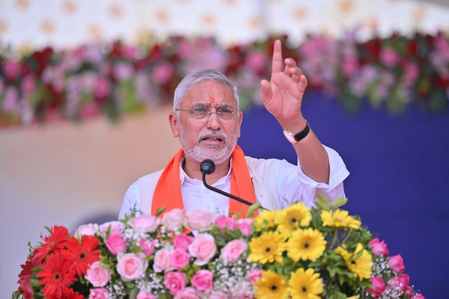
Surat, March 15 (IANS) Gujarat Bharatiya Janata Party (BJP) president Jagdish Vishwakarma on Sunday described the Congress as a “4-C” party — standing for corruption, commission, communal riots and criminal politics — while addressing a large booth workers’ conference in Mahuva in Surat district.
Speaking at the gathering during the third day of the party’s organisational tour of South Gujarat, Vishwakarma said the opposition had spent decades in power without addressing people’s concerns.
“Congress means ‘4-C’ — corruption, commission, communal riots and criminal politics,” he said, contrasting it with what he described as corruption-free governance under the BJP.
He also accused opposition leaders of spreading rumours and focusing on protests rather than parliamentary debate.
Referring to recent political exchanges over LPG prices, he alleged that Congress leaders were circulating misinformation and criticised an incident in which opposition members were seen sitting on the steps of Parliament.
“Instead of raising people’s concerns in Parliament, opposition leaders spread rumours and only work to protest outside Parliament,” he said.
Vishwakarma told party workers that the BJP had provided governance based on “no casteism, no dynastic politics and no appeasement”.
According to him, the party’s organisational workers remain among the public continuously rather than engaging with people only during election periods.
“Under the leadership of Prime Minister Narendra Modi, Union Home Minister Amit Shah and Chief Minister Bhupendra Patel, the government was working with a firm commitment to double farmers’ income,” he said.
He described South Gujarat as a key centre of agriculture and cooperative activity, noting that the region’s achievements in the cooperative sector had become a model for the country.
Highlighting development works in the area, Vishwakarma said that over the past decade, around 76 small and large bridges had been built in the local Assembly segment at a cost exceeding Rs 500 crore.
Construction of a four-lane road from Bardoli to Anaval at a cost of Rs 376 crore and a tribal Adarsh Residential School in Nalotha village built for Rs 51 crore were among projects he cited as examples of infrastructure expansion.
He also said a new bridge was under construction to connect Samba to the Brahmadev Temple area.
Recalling Surat’s historical significance, he said: “The city had long been an important trading port and that its entrepreneurial traditions remained relevant today.”
The BJP leader said the cooperative model of Amul and Sumul was widely recognised across the country and that more than 150 products from the sector were exported overseas.
“The government was encouraging natural farming and working to ensure better prices for agricultural produce,” he claimed.
Among welfare measures, Vishwakarma mentioned the Ayushman health card scheme, LPG cylinders provided under the Ujjwala programme, financial support through the PM Kisan Samman Nidhi scheme and marketing support for millets such as nagli in tribal areas.
He also said the income eligibility limit for Scheduled Caste students had been increased from Rs 2.5 lakh to Rs 6 lakh to support higher education for students from middle-income and poorer families.
“Today, for the people of Gujarat and the country, the BJP means a synonym for development and a name of trust,” he said, adding that party workers were committed to the goal of a developed India by 2047.
Earlier in the day, Vishwakarma held an organisational meeting with district-level BJP office-bearers, MPs, MLAs, the district panchayat president, campaign presidents, general secretaries and local leaders to review organisational matters.
–IANS
mys/uk