Radio Brisvaani

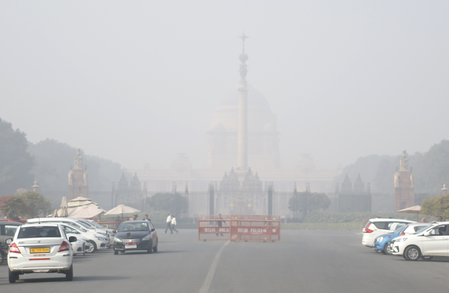
New Delhi, Jan 5 (IANS) Delhi’s air quality remained in the ‘poor’ category on Monday morning as the national capital continued to reel under a cold wave. The minimum temperature dropped sharply by 4.5 degrees Celsius, settling at 6.5 degrees Celsius, which is below the seasonal average.
Area-wise data indicated that the Air Quality Index (AQI) continued to hover in the poor range across most parts of the city. Akshardham recorded an AQI of 294, while ITO registered 256, according to data released by the Central Pollution Control Board (CPCB).
However, as many as 11 monitoring stations reported ‘very poor’ air quality. These included Anand Vihar, Ashok Vihar, and Chandni Chowk, areas that are often among the most polluted in the capital. Anand Vihar recorded an AQI of 323, Ashok Vihar 304, and Chandni Chowk registered a particularly high AQI of 343. Other stations in the very poor category included IHBAS in Dilshad Garden (310), Jahangirpuri (326), Nehru Nagar (329), Okhla Phase II (304), Rohini (313), Sirifort (306), Vivek Vihar (321), and Wazirpur (313).
Neighbouring cities also witnessed a decline in air quality. Noida’s AQI deteriorated to 242, compared to 229 recorded on Friday. Gurugram, which had briefly shown improvement by entering the ‘moderate’ category with an AQI of 178 on Friday, slipped back into the ‘poor’ category on Saturday with an AQI of 244.
Authorities had earlier lifted the Graded Response Action Plan (GRAP) restrictions across Delhi-NCR, citing an improvement in air quality due to rainfall and strong winds. However, GRAP-1 and GRAP-2 curbs continue to remain in force as a precautionary measure.
As per official classification, an AQI between 201 and 300 is considered ‘poor’, between 301 and 400 ‘very poor’, and between 401 and 500 ‘severe’.
Meanwhile, the India Meteorological Department (IMD) has forecast that a cold wave will affect isolated places in the national capital till January 6. The weather agency has predicted mainly clear skies, with shallow to moderate fog during the morning hours.
Delhi’s maximum and minimum temperatures are likely to range between 17 degrees Celsius and 19 degrees Celsius, and 7 degrees Celsius and 9 degrees Celsius, respectively. The minimum temperatures are expected to remain slightly above normal, by about 0.1 degrees Celsius to 2.1 degrees Celsius, while maximum temperatures are likely to stay near normal.
IMD data showed noticeable variation in night temperatures across different parts of the city. Safdarjung, Delhi’s primary weather observatory, recorded a minimum temperature of 7.4 degrees Celsius. Palam reported a lower minimum of 6.8 degrees Celsius, while Ayanagar recorded 6.6 degrees Celsius. Lodhi Road registered 7.6 degrees Celsius, whereas the Ridge area was relatively warmer at 8.9 degrees Celsius. High relative humidity levels, recorded at 92 per cent at 8.30 a.m., further intensified the cold, making early morning conditions more uncomfortable.
The IMD has also forecast light rain or snowfall at isolated places in the higher reaches of north and central Kashmir and Himachal Pradesh on January 5 and 6. Isolated areas in Uttarakhand are likely to receive rain or snow on January 6.
According to the Meteorological Department, Kashmir is currently experiencing a cold wave, which locals call ‘Chilla-e-Kalan’, the harshest 40-day winter period, during which night temperatures often drop well below the freezing point. However, the plains of the valley have not received any snowfall so far this season.
Cold wave conditions are also expected to persist over isolated pockets of Punjab, Haryana, and Chandigarh till January 8. In West Rajasthan, these conditions are likely to continue till January 9, while East Rajasthan may experience a cold wave until January 10.
–IANS
jk/dpb