
Radio Brisvaani

New Delhi, March 16 (IANS) Highlighting a “whole-of-government” and a “whole-of-society” approach, the Environment Ministry has submitted India’s Seventh National Report (NR-7) to the Convention on Biological Diversity (CBD), an official said on Monday.
The submission on February 26, as part of a mandatory obligation, reaffirms India’s strong commitment to achieving the objectives of the Convention on Biological Diversity and delivering on global biodiversity goals by 2030 under the Kunming–Montreal Global Biodiversity Framework, the official said in a statement.
The Report said that all 23 National Biodiversity Targets (NBTs) are currently “on track to achieve”, demonstrating strong alignment between national priorities and global biodiversity commitments.
The report emphasises a “whole-of-government” and “whole-of-society” approach, reflecting long-standing practices in India’s biodiversity conservation efforts. It highlights the engagement of 33 Central Ministries/Departments, integrating biodiversity safeguards across infrastructure, agriculture, forestry and coastal sector policies.
India has substantially strengthened biodiversity-inclusive land and seascape planning. Recorded Forest Area stands at 7,75,377 sq km (23.59 per cent of geographical area), of which forest cover constitutes 5,20,365 sq km (15.83 per cent).
Total Forest and Tree Cover has reached 8,27,356.95 km2 (25.17 per cent), reflecting sustained integration of spatial planning. The number of notified Ramsar wetlands of international importance has expanded from 26 in 2014 to 98 as of 2026, according to the report.
The NR-7 presents a comprehensive, indicator-based national assessment aligned with India’s updated National Biodiversity Strategy and Action Plan (NBSAP 2024-2030) and the Kunming-Montreal Global Biodiversity Framework (KMGBF).
The report is based on 142 national indicators mapped against 23 National Biodiversity Targets (NBTs). The assessment reflects coordinated inputs from 33 Central Ministries/Departments, State Governments, Statutory Authorities, Research Institutions and other stakeholders, said the statement issued by the Ministry of Environment, Forest and Climate Change.
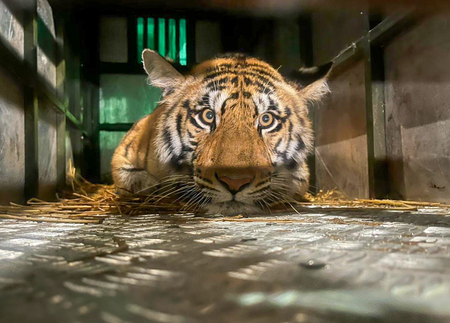
India’s conservation network now encompasses 58 Tiger Reserves, 33 Elephant Reserves, 18 Biosphere Reserves, 106 National Parks and 574 Wildlife Sanctuaries. India supports 3,682 tigers (over 70 per cent of the global tiger population), 4,014 greater one-horned rhinoceroses, 22,446 wild elephants, 891 Asiatic lions, and about 718 snow leopards, as estimated through the first Snow Leopard Population Assessment (SLPAI). Under the project Dolphin, the finalised and released report on the first-ever river dolphin population estimate found a population of 6,327 river dolphins in the country.
India has documented 22 agrobiodiversity hotspots and prioritised the conservation of 769 Crop Wild Relatives (CWRs) across 171 native crops and 230 native animal breeds, based on diversity, uniqueness, and agricultural heritage, the report said.
India’s National Biodiversity Authority has issued over 5,600 access and benefit sharing (ABS) agreements disbursing Rs 140 crore, while 2,76,653 Biodiversity Management Committees (BMCs) and 2,72, 648 People’s Biodiversity Registers (PBRs) engage local communities and traditional knowledge to promote biodiversity-friendly practices, the report said.
–IANS
rch/uk