Radio Brisvaani

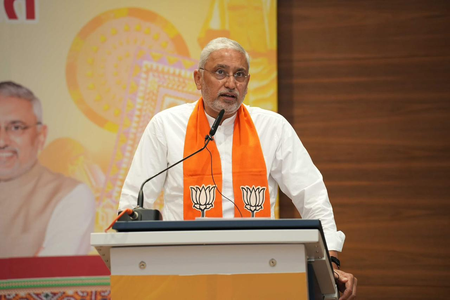
Gandhinagar, Feb 19 (IANS) Gujarat contributes 8.2 per cent to India’s gross domestic product (GDP), with a per capita income of Rs 3,01,000, around 60 per cent higher than the national average, demonstrating the state’s economic strength, said state BJP President Jagdish Vishwakarma on Thursday.
Speaking at a press conference in Gandhinagar, Vishwakarma congratulated Chief Minister Bhupendra Patel and state Finance Minister Kanu Desai for presenting the Rs 4,08,053 crore budget for the financial year 2026-27, describing it as a “quantum jump” towards a developed Gujarat by 2047.
He noted that the Budget reflects the aspirations of 6.5 crore Gujaratis, represents a 10.2 per cent increase over last year, and has been presented without introducing any new taxes.
“This Budget aims to accelerate the state’s uninterrupted development journey. It focuses on the welfare of the poor, youth, farmers, and women, following the principle of ‘Sarv Sukhay, Sarv Hitay’ (for the happiness and benefit of all),” he said.
The Budget is structured around a six-point framework: Talent, Technology, Transformation, Tourism, Trust, and Transparency.
It emphasises human development, employment, education, health, infrastructure, tourism, technology, and artificial intelligence, alongside heritage preservation.
Vishwakarma highlighted that under the Pradhan Mantri Awas Yojana, 3.15 lakh new houses will be constructed for poor families and workers, while 75 lakh families will receive free ration.
Fifty new Dhanvantari Health Raths and 121 centres under the Shram Annapurna Yojana will provide nutritious meals at Rs five.
Over 2.72 crore people will benefit from the PM Jan Arogya and Chief Minister Amrutam schemes, and Rs 260 crore has been allocated for workers’ skill enhancement.
The Gujarat Kaushalya and Rozgar Mission has been provided Rs 226 crore, and a research park will be established at L.D. Engineering College, Ahmedabad, alongside regional start-up centres in Surat, Vadodara, Mehsana, and Rajkot.
In education, 16 new government colleges and 926 PM Shri schools will be set up, and the country’s largest modern library will be developed in Gandhinagar.
For early childhood education, Rs 360 crore has been allocated for 2,000 new Anganwadis, while Rs 400 crore has been earmarked under the Chief Minister Yuva Swavalamban Yojana for meritorious students.
Farmers and livestock owners will benefit from over Rs 11,000 crore under the agriculture relief package, with MSP procurement valued at over Rs 18,000 crore.
Rs 1,539 crore has been allocated for interest subsidy under the Kisan Credit Scheme, and new initiatives for women’s empowerment, including the ‘Lakhpati Didi’ campaign and ‘Kaushalya Lakshmi Yojana’, have been announced.
Tribal development has been allocated over Rs 35,000 crore, including irrigation projects, five new GIDCs, and increased scholarship limits for Scheduled Caste and Scheduled Tribe students from Rs 2.5 lakh to Rs six lakh.
Infrastructure projects include the development of five new satellite towns, Kalol, Sanand, Savli, Bardoli, and Hirasar, to ease urban congestion, 1,155 km of the Garvi Gujarat High-Speed Corridor, and the Somnath-Dwarka Expressway.
A Rs 50,000 crore ‘Developed Gujarat Fund’ has been created, while green initiatives include floating solar at Kadana Dam and waste management to achieve a ‘Dump-Free Gujarat’.
Industrial development plans include upgrading 25 GIDCs to smart centres and modernising 120 mini-GIDCs.
Vishwakarma also noted that Ahmedabad will host the Commonwealth Games, with Rs 1,200 crore allocated for sports infrastructure and transport.
The year 2026 has been declared ‘Gujarat Tourism Year’, with Somnath designated as a ‘Global Destination’.
Rs 850 crore has been allocated for AI and digital governance initiatives, and the GRIT institution has been established.
–IANS
mys/svn