Radio Brisvaani

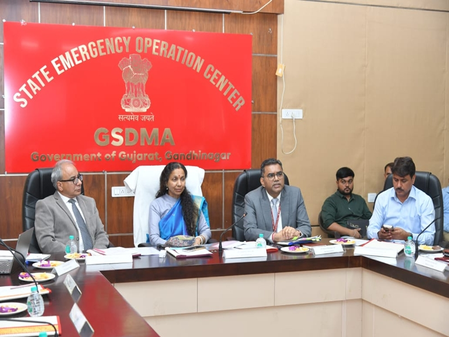
Gandhinagar, March 6 (IANS) A national-level meeting on ‘Disaster Preparedness in Gujarat’ was held in Gandhinagar on Friday, bringing together officials from Central and state agencies to review preparedness against natural and man-made disasters.
The aim is to strengthen coordination mechanisms aimed at reducing risks and improving emergency response.
The meeting was organised at the State Emergency Operation Centre (SEOC) by the National Disaster Management Authority (NDMA) and the Gujarat State Disaster Management Authority (GSDMA), and was chaired by Revenue Department Additional Chief Secretary Dr Jayanti Ravi.
Speaking during the meeting, Ravi said disaster management today goes far beyond relief and rehabilitation and must focus equally on prevention, awareness and long-term planning.
“Disaster management is no longer limited to relief and rehabilitation. It now includes prevention, awareness and comprehensive planning,” she said.
She said Gujarat’s disaster management framework has been aligned with the central government’s policies and Prime Minister Narendra Modi’s 10-point agenda on Disaster Risk Reduction (DRR).
According to Ravi, the state’s preparedness mechanisms extend from urban centres to the village level.
Referring to operational preparedness, she said the SEOC coordinates with districts and talukas during emergencies to ensure a unified response.
“Our experiences from past cyclones and floods, along with regular mock drills, have helped strengthen preparedness across the state,” she said, adding that special attention has been given to safety exercises at oil and gas installations and nuclear facilities.
Dr Ravi said several initiatives have been launched by the state government under the guidance of Chief Minister Bhupendra Patel and the leadership of Minister of State for Revenue and Disaster Management Sanjaysinh Mahida.
Among them is the ‘Prepared Community, Safe Village’ programme, through which citizens at the village and taluka levels are receiving online and hybrid training through BISAG.
She added that disaster management funds are being utilised to strengthen infrastructure, including electricity tower connectivity and ensuring uninterrupted power supply.
The government has also decided to provide primary equipment kits to more than 18,000 gram panchayats across the state.
NDMA Secretary Manish Bhardwaj emphasised the importance of community participation in disaster response.
“The most important aspect during disasters is the role of community volunteers. In any emergency, the first response always comes from local citizens,” he said.
Bhardwaj said wider sections of society should receive basic emergency training.
“Ordinary citizens, drivers and traders should be trained in CPR and first aid so that immediate assistance can be provided before professional responders arrive,” he said.
He also stressed the need for strict fire safety compliance in schools and faster emergency response systems. “In the event of a fire anywhere in the state, the response time of the fire brigade should be less than five minutes,” he said.
He further highlighted the need to equip forest departments with modern technology and equipment to prevent incidents such as forest fires.
Bhardwaj said cities across the country must strengthen their capacity to deal with disasters such as floods and cloudbursts.
“Essential services like electricity, drainage and transport should not be disrupted during emergencies, and this requires coordinated work across all departments,” he said.
NDMA Member Dinesh Kumar Aswal said disaster management must be viewed as a process that begins long before an emergency occurs.
“Disaster management is not only a post-disaster activity; it is about preparedness and reducing risks through advance planning,” he said.
He pointed out that states such as Gujarat, where chemical industries are widespread, require scientific and data-based planning to reduce the risk of industrial accidents.
“Risk mapping and the use of technology are essential so that departments can identify vulnerabilities and prepare effective disaster management plans,” he said.
Aswal also referred to emerging risks caused by climate change.
“Global warming and irregular rainfall are leading to new threats such as urban flooding and heatwaves, and these require early warning systems and advance preparedness,” he said.
Discussing financial support for such initiatives, he said the 16th Finance Commission has allocated significant funds for disaster management.
“Departments must prepare mitigation projects and link them with the National Disaster Management Portal to make effective use of these funds,” he said, adding that allocations for Gujarat have also been increased.
The meeting was attended by senior officials, along with officials from the NDRF, SDRF, BSF, IMD, Gujarat Maritime Board and several other departments including animal husbandry, agriculture, fire, safety and health.
–IANS
mys/pgh