Radio Brisvaani

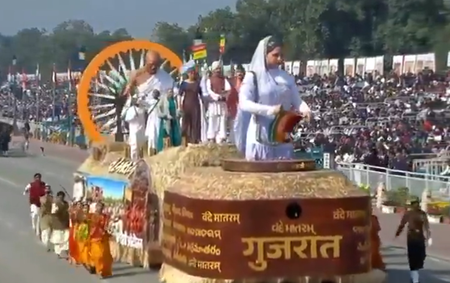
New Delhi, Jan 26 (IANS) At the 77th Republic Day parade on Kartavya Path, Gujarat’s tableau aligned with the theme “Swatantrata Ka Mantra: Vande Mataram”, showcased the evolution of the Indian Flag on Monday.
Gujarat’s tableau was a major attraction at the R-Day parade, showcasing the journey of the Tricolour, its evolution, and its rich history.
The tableau brought together the inspiring story of the flag inscribed with ‘Vande Mataram’ prepared by Madam Bhikaiji Cama, born in Navsari, Gujarat, who ignited the flame of revolution from foreign soil with fellow Gujarati revolutionaries Shyamji Krishna Varma and Sardarsinhji Rana, the legacy of Mahatma Gandhi’s swadeshi message through the charkha, and the spirit of today’s ‘Atmanirbhar Bharat’ campaign.
At the forefront of the tableau, the valiant Madam Bhikhaiji Cama was depicted holding the self-created ‘Vande Mataram’-inscribed flag, which she first unfurled on foreign soil in Paris in 1907. This flag was also presented at the ‘Indian Socialist Conference’ in Stuttgart, Berlin, Germany.
Beneath the half-statue of Madam Cama waving the flag, the words ‘Vande Mataram’ were inscribed in various Indian languages recognised in the Constitution.
The heart of the tableau, its background section, portrayed the journey of the making of the National Flag, its changing form, and its history, beginning from the year 1906.
The revolutionaries first hoisted the flag with ‘Vande Mataram’ written on it while celebrating the boycott of foreign goods and accepting Swadeshi in the Parsi Bagan of Kolkata.
Subsequently, in 1907, Madam Bhikhaiji Cama, who unfurled the flag she had prepared in Paris. In 1917, as part of the Home Rule Movement, a new flag was unfurled by Annie Besant and Bal Gangadhar Tilak, while in 1921 at Vijayawada, young revolutionary Pingali Venkayya designed a new flag and presented it to Gandhiji. In 1931, a flag prepared by Pingali with certain modifications, featuring the charkha and three colours, was almost accepted.
Finally, on July 22, 1947, the Constituent Assembly of India approved the tricolour with the Dharma Chakra at its centre. Alongside this journey of the National Flag, the tableau also depicted major movements of India’s freedom struggle.
In the final segment of the tableau, a sculpture of Mahatma Gandhi, who called for freedom through the experiment of Swadeshi using the charkha, was depicted along with a large Dharma Chakra.
Remembering the brave sons who sacrificed their lives for the freedom struggle, artists performing to the rhythm of ‘Kasumbi No Rang’, composed by renowned Gujarati poet Jhaverchand Meghani, fondly known as the ‘National Poet’, infused the tableau with enthusiasm and patriotic fervour.
This year, a total of 30 tableaux were displayed at the Republic Day parade, comprising 17 states and Union Territories and 13 tableaux from various departments of the Central Government. Nearly 2,500 artists participated in the cultural performances on the Kartavya Path. Around 10,000 special guests from across the country were invited.
–IANS
mr/dan